Warehouse Safety Barriers: Types, Applications and How to Choose

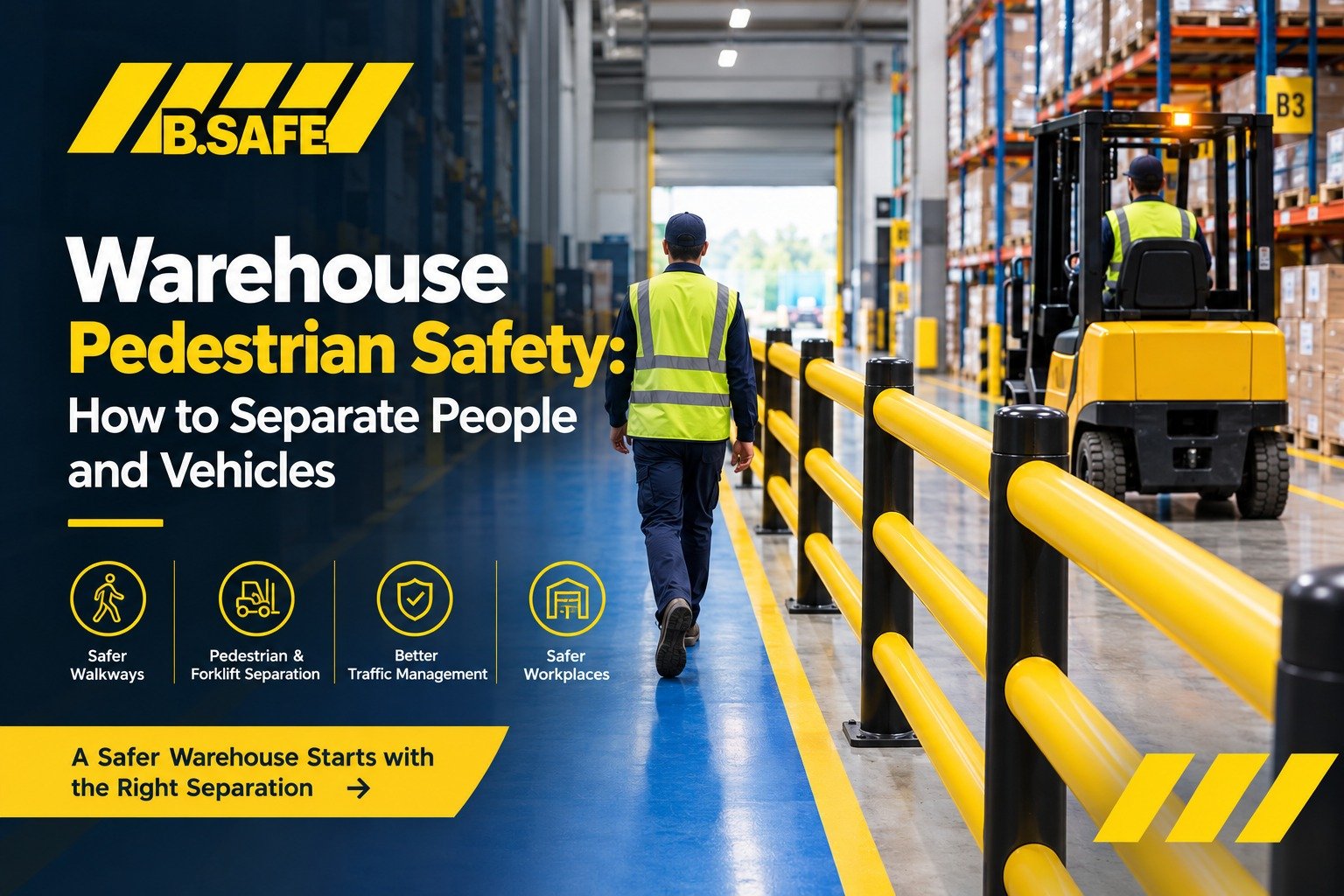
Warehouse Safety Barriers: Types, Applications and How to Choose
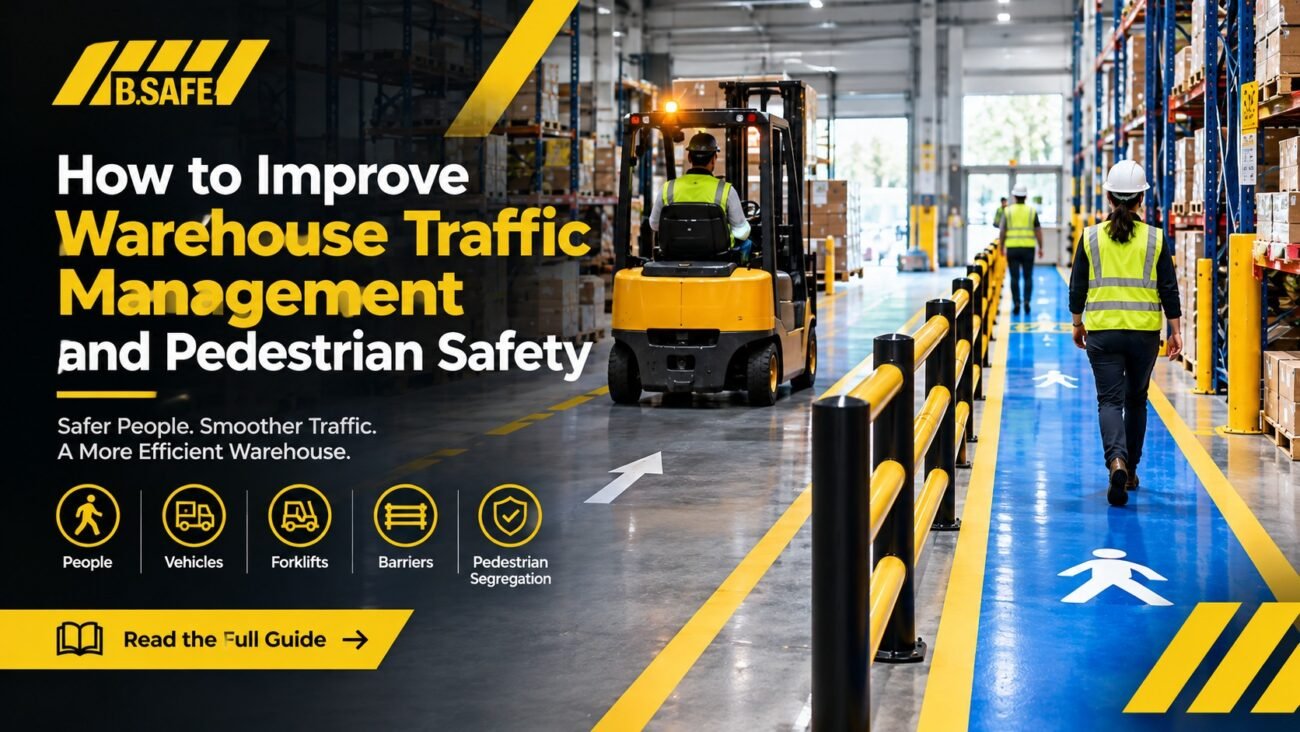
Warehouses are busy environments where forklifts, pallet trucks, delivery vehicles, pedestrians, racks, machinery, and stored goods often operate in close proximity.
Without proper separation and impact protection, a single vehicle movement can result in damage to warehouse infrastructure, racking, equipment, or create a serious safety hazard for workers.
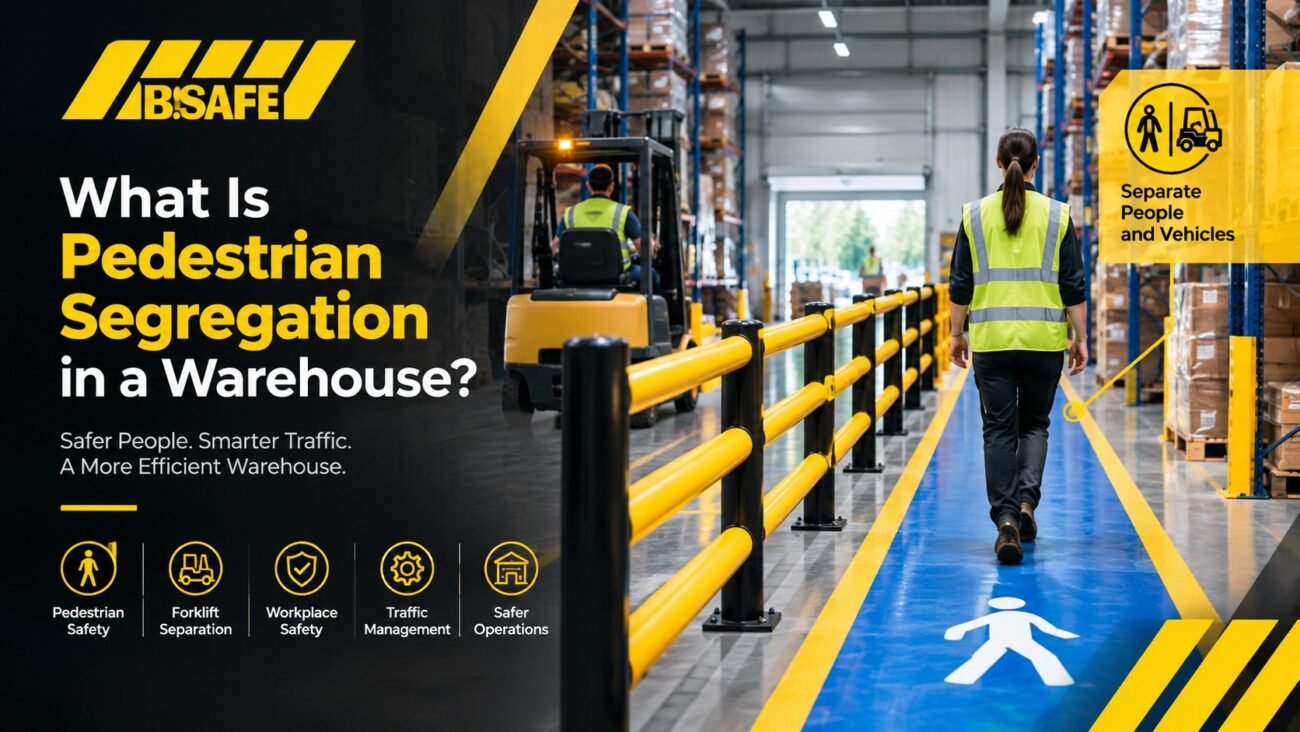
Warehouse safety barriers provide a practical way to separate people and vehicles, protect vulnerable infrastructure, define traffic routes, and reduce exposure to vehicle impacts.
But not every warehouse requires the same type of barrier.
 A pedestrian walkway may need a different solution from a rack end, loading bay, doorway, column, or high-traffic vehicle route.
In this guide, we explain the main types of warehouse safety barriers, where they are used, and how to choose the right warehouse protection barriers for your facility.
What Are Warehouse Safety Barriers?
Warehouse safety barriers are physical protection systems designed to help separate people, vehicles, equipment, and critical infrastructure within warehouses and industrial workplaces.
Depending on their design and application, safety barriers can be used to:
- Separate pedestrians from forklift traffic
- Protect warehouse racking
- Protect columns, doors, and machinery
- Define vehicle traffic routes
- Protect loading and unloading areas
- Control access through specific points
- Protect vulnerable warehouse infrastructure
- Reduce damage caused by vehicle impacts
- Improve warehouse traffic management
A properly designed warehouse protection system should be based on the actual risks within the facility rather than simply installing the same barrier everywhere.
For warehouses with significant pedestrian and forklift interaction, physical separation can be an important part of a broader workplace safety strategy.
Why Are Industrial Safety Barriers Important?
A warehouse can contain multiple vehicle and pedestrian conflict points.
For example, a forklift may travel through the same area used by employees walking between storage, picking, production, and loading areas.
Other risks can occur when vehicles turn near:
- Racking
- Pedestrian walkways
- Doors
- Columns
- Loading bays
- Production areas
- Machinery
- Storage areas
Industrial safety barriers can create a physical boundary between these activities.
However, a barrier should not be selected simply because it looks strong.
The correct system should be based on the actual risk, vehicle characteristics, impact conditions, traffic flow, and location.
For a broader look at separating people and vehicles, see our guide to Warehouse Pedestrian Safety: How to Separate People and Vehicles.
Main Types of Warehouse Safety Barriers
Different areas of a warehouse require different types of protection.
Common warehouse protection solutions include:
- Pedestrian safety barriers
- Traffic barriers
- Bollards
- Rack-end barriers
- Rack-end barriers with kerbs
- Height restrictors
- Safety gates
- Specialized impact protection systems
Understanding the purpose of each type makes it easier to choose the right solution.
1. Pedestrian Safety Barriers
Pedestrian safety barriers are designed to create a physical separation between people and vehicle traffic.
They are particularly useful where employees need to walk close to forklifts or other powered industrial vehicles.
Typical applications include:
- Warehouse pedestrian walkways
- Distribution centers
- Manufacturing facilities
- Production areas
- Forklift routes
- Pedestrian crossings
- Warehouse entrances
- High-traffic areas
A dedicated pedestrian barrier can make the intended route much clearer than floor markings alone.
iFlex Pedestrian Barrier 3 Rail
The iFlex Pedestrian Barrier 3 Rail is designed to help segregate pedestrians from moving vehicles and workplace hazards while defining pedestrian routes.
Its flexible construction is designed for impact protection and can be used in indoor and outdoor environments.
For warehouses where pedestrians and vehicles operate close to one another, this type of system can form part of a broader pedestrian segregation strategy.
Best use: pedestrian walkways, forklift routes, warehouse traffic separation, and areas where people and vehicles operate close together.
2. Traffic Barriers
Traffic barriers are generally used when the primary objective is to protect infrastructure from vehicle movement and define vehicle routes.
They can be installed around:
- Machinery
- Buildings
- Doors
- Warehouse infrastructure
- High-risk vehicle routes
- Loading areas
- Equipment
- Operational zones
Traffic barriers can also help guide forklift movement through a facility.
iFlex Double Traffic Barrier
The iFlex Double Traffic Barrier can be used where warehouse areas require physical vehicle protection and clearer separation between vehicle routes and vulnerable areas.
It can form part of a wider warehouse traffic management strategy alongside pedestrian barriers, rack protection, and other impact protection systems.
Best use: vehicle routes, high-traffic areas, and warehouse infrastructure requiring additional impact protection.
iFlex Single Traffic Barrier Cold Storage
Cold storage facilities have different environmental requirements from standard warehouses.
Where vehicle traffic operates in low-temperature environments, protection systems should be selected specifically for those conditions.
The iFlex Single Traffic Barrier Cold Storage is designed for cold-storage applications where vehicle and infrastructure protection must account for low-temperature operating conditions.
Best use: cold-storage facilities, freezer warehouses, and areas exposed to vehicle traffic in low-temperature environments.
3. Warehouse Bollards
Not every warehouse hazard requires a continuous barrier.
Sometimes the risk is concentrated around a specific asset.
This is where bollards can be useful.
Warehouse bollards can provide localized impact protection around:
- Doorways
- Columns
- Machinery
- Equipment
- Building corners
- Access points
- Vulnerable infrastructure
iFlex Bollard
The iFlex Bollard can be used where individual points require localized protection from vehicle movement.
This can be useful around doors, columns, equipment, access points, and other warehouse infrastructure.
Best use: localized protection for individual assets rather than continuous pedestrian separation.
4. Rack-End Protection Barriers
Warehouse racking is particularly vulnerable to forklift impacts.
Forklifts frequently approach rack ends while turning into aisles, placing these areas at risk of vehicle contact.
Rack-end barriers are designed to provide protection around the exposed ends of warehouse racking.
They can help protect:
- Rack uprights
- Stored goods
- Aisle ends
- Warehouse infrastructure
- Forklift routes around racking
Rack protection should be considered separately from general pedestrian protection because the impact location and vehicle movement can be very different.
iFlex Single RackEnd Barrier
The iFlex Single RackEnd Barrier is designed for rack-end protection where warehouse racking is exposed to vehicle movement.
It can be incorporated into a wider warehouse protection strategy alongside pedestrian barriers and traffic barriers.
Best use: rack ends, storage aisles, and areas where forklifts regularly turn near warehouse racking.
5. Rack-End Barriers with Kerbs
Some warehouse risks occur very close to floor level.
Forks from pallet trucks and other material-handling equipment can pass underneath conventional rails and potentially contact racking or stored goods.
A rack-end barrier combined with a kerb can provide additional low-level protection.
eFlex Single RackEndKerb
The eFlex Single RackEndKerb can be considered where warehouse racking requires protection at both the rack-end area and lower level.
This type of solution can be useful where warehouse racking is exposed to low-level vehicle and fork impacts.
Best use: rack-end areas where lower-level protection is also required.
6. Height Restrictors
Some warehouse areas have limited clearance.
Examples include:
- Roller shutter doors
- Door frames
- Loading entrances
- Low-clearance structures
- Overhead equipment
- Restricted-height access points
A forklift or other vehicle carrying a raised load can potentially strike these areas.
iFlex Height Restrictor
The iFlex Height Restrictor can be used to help define restricted-height areas and provide a visible physical warning for vehicle operators.
It can form part of a broader warehouse traffic management strategy where overhead clearance is a concern.
Best use: warehouse entrances, doorways, restricted-height areas, and locations where overhead clearance needs additional protection.
7. Safety Gates for Controlled Access
Some warehouse areas need more than a fixed barrier.
A gate can allow controlled movement through a pedestrian or vehicle route while maintaining a physical boundary when access is not required.
iFlex Slide Gate
The iFlex Slide Gate can be used to provide controlled access through protected areas.
A gate can be particularly useful where pedestrians, vehicles, or equipment need to pass through a defined opening while maintaining separation when the opening is not in use.
Best use: controlled pedestrian or vehicle access points within warehouse and industrial environments.
8. Specialized Impact Protection
Not every protection product is intended for the same environment.
The vehicle type, impact energy, operating area, and infrastructure being protected all matter.
Some specialized barriers are designed for environments such as airports or other high-impact applications rather than being the default choice for a standard warehouse.
Atlas Polygon Traffic Barrier
The Atlas Polygon Traffic Barrier is a specialized impact protection solution designed for applications such as airport stands and apron areas.
It can protect vulnerable infrastructure such as columns, masts, and ground-mounted equipment from vehicle impacts.
For a standard warehouse pedestrian segregation project, it should not automatically be treated as the primary solution.
The correct barrier should always match the actual operating environment and risk.
Warehouse Safety Barriers vs. Floor Markings
Floor markings are useful for warehouse traffic management.
They can identify:
- Pedestrian walkways
- Forklift lanes
- Crossings
- Restricted areas
- Stop points
- Direction of travel
However, floor markings are a visual control.
They do not physically prevent a vehicle from entering a pedestrian area.
Where the risk requires stronger separation, a physical barrier may provide a more appropriate engineering control.
The most effective warehouse traffic strategy may therefore combine:
Floor markings + Physical barriers + Signs + Visibility controls + Traffic procedures
The correct combination depends on the warehouse layout and risk assessment.
How to Choose the Right Warehouse Protection Barrier
Choosing a warehouse protection barrier should start with the hazard rather than the product.
Before selecting a system, evaluate the installation location.
1. Identify the Hazard
First determine what needs protection.
Is the objective to protect:
- People?
- Forklifts?
- Racking?
- Machinery?
- Doors?
- Columns?
- Loading bays?
- Stored products?
- Building infrastructure?
The answer will immediately narrow down the appropriate barrier type.
2. Consider the Vehicle
Identify the vehicles operating in the area.
For example:
- Counterbalance forklifts
- Reach trucks
- Pallet trucks
- Powered industrial trucks
- Delivery vehicles
- Industrial carts
Different vehicles can create different impact conditions.
3. Consider Vehicle Weight
The potential impact energy is affected by vehicle mass.
A barrier suitable for a pedestrian walkway may not be appropriate for an area exposed to heavier vehicles.
4. Consider Vehicle Speed
Vehicle speed is another important factor.
A warehouse with slow-moving pallet trucks may have different protection requirements from a high-volume distribution center with frequent forklift traffic.
5. Consider Impact Angle
Vehicle impacts do not always occur straight into a barrier.
Forklifts may contact barriers while:
- Turning
- Reversing
- Entering aisles
- Leaving aisles
- Approaching corners
- Moving through intersections
Shallow-angle impacts should therefore be considered during the selection process.
6. Consider Impact Height
The height of the expected vehicle impact is also important.
A rack-end barrier, pedestrian barrier, bollard, and height restrictor address different impact zones.
The protection system should match the expected point of contact.
7. Consider Pedestrian Traffic
If people work close to vehicle routes, assess:
- Number of pedestrians
- Traffic frequency
- Walkway width
- Crossing points
- Shift patterns
- Visitor movement
- Emergency routes
High pedestrian traffic may justify stronger physical separation.
8. Consider the Environment
The warehouse environment can affect product selection.
Consider whether the barrier will be installed in:
- Standard indoor warehouse
- Outdoor yard
- Distribution center
- Manufacturing facility
- Loading area
- Cold storage
- High-traffic zone
- Specialized industrial environment
Where Should Warehouse Safety Barriers Be Installed?
There is no single layout that works for every warehouse.
However, several areas deserve particular attention.
Warehouse Pedestrian Walkways
Use pedestrian barriers where people need to move close to forklift routes.
The objective is to create a clearly defined pedestrian route and reduce unnecessary interaction with vehicles.
For more information, see our guide to Pedestrian and Forklift Separation in Warehouses: Best Practices.
Forklift Intersections
Intersections can create conflict points where pedestrians and forklifts approach from different directions.
Use appropriate combinations of:
- Physical barriers
- Marked crossings
- Mirrors
- Warning signs
- Visibility controls
- Traffic procedures
Racking Aisles
Protect rack ends where forklifts turn into or out of storage aisles.
Rack-end protection can reduce exposure of racking to vehicle impacts.
Loading Areas
Loading and unloading zones can contain forklifts, trucks, pedestrians, pallets, doors, and other equipment.
Physical barriers can help define traffic routes and protect vulnerable areas.
Doorways and Access Points
Doors can become vehicle-pedestrian conflict points.
Where forklifts and pedestrians approach the same doorway, consider physical separation, controlled access, visibility, and traffic procedures.
Columns and Machinery
Individual assets can often be protected with bollards or localized barriers.
This can be more appropriate than installing a continuous barrier throughout the facility.
Warehouse Safety Barriers and Pedestrian Protection
Pedestrian protection should be one of the main considerations when planning warehouse traffic routes.
A practical approach is to create dedicated pedestrian areas wherever possible.
A physical barrier can make the intended separation clearer and more difficult to accidentally cross.
For warehouses with significant pedestrian and forklift interaction, pedestrian barriers can therefore form an important part of the overall traffic management system.
The iFlex Pedestrian Barrier 3 Rail is one example of a dedicated pedestrian segregation solution.
Warehouse Protection Is More Than Pedestrian Safety
A common mistake is to focus only on protecting workers.
Forklifts can also cause expensive damage to:
- Warehouse racking
- Doors
- Columns
- Machinery
- Loading infrastructure
- Stored products
- Building structures
This means a complete warehouse protection strategy should consider both people and assets.
A facility may need a combination of:
- Pedestrian barriers
- Traffic barriers
- Bollards
- Rack-end protection
- Kerb protection
- Height restrictors
- Safety gates
Using multiple barrier types can provide more targeted protection than trying to use one product throughout the entire warehouse.
Flexible Safety Barriers vs. Traditional Steel Barriers
When selecting a warehouse barrier, material and impact behavior should also be considered.
Traditional steel barriers can provide a rigid physical boundary, but vehicle impacts can cause deformation and may require repair or replacement.
Flexible polymer safety barrier systems are designed differently.
Depending on the product, they can absorb and deflect impact forces and may be designed for repeated impact exposure.
This does not mean that every flexible barrier is suitable for every impact condition.
The correct system still needs to be selected based on:
- Vehicle weight
- Vehicle speed
- Impact angle
- Impact height
- Barrier location
- Environmental conditions
- Required protection level
How to Build a Complete Warehouse Safety Barrier System
A strong warehouse protection strategy usually combines several solutions.
Pedestrian Areas
Use pedestrian barriers to separate people from vehicle routes.
The iFlex Pedestrian Barrier 3 Rail is designed specifically around pedestrian segregation.
Vehicle Routes
Use traffic barriers to define and protect vehicle movement areas.
The iFlex Double Traffic Barrier is one option within the B.SAFE Warehouse Solutions range.
Racking
Use rack-end barriers and lower-level protection around vulnerable rack locations.
Consider the iFlex Single RackEnd Barrier or eFlex Single RackEndKerb depending on the application.
Individual Assets
Use bollards around columns, doors, machinery, and other critical assets.
The iFlex Bollard provides a localized protection option.
Restricted Heights
Use height restrictors where overhead clearance presents a vehicle impact risk.
See the iFlex Height Restrictor for this type of application.
Controlled Access
Use gates where pedestrians or vehicles need controlled passage through a protected area.
The iFlex Slide Gate can be incorporated into an access-control and segregation strategy.
Common Mistakes When Choosing Warehouse Safety Barriers
Choosing a Barrier Based Only on Appearance
A barrier may look strong but still be unsuitable for the actual impact conditions.
Using One Barrier Type Everywhere
Different hazards require different protection.
A pedestrian walkway does not have the same requirements as a rack end or loading bay.
Ignoring Vehicle Characteristics
Vehicle weight, speed, impact angle, and impact height should be considered.
Relying Only on Floor Markings
Paint can define a route but cannot physically stop a vehicle.
Protecting Racking but Ignoring Pedestrians
Warehouse safety should consider both people and infrastructure.
Installing Protection Without Reviewing Traffic Flow
A barrier can change how people and vehicles move through a facility.
The complete traffic route should be considered before installation.
Forgetting Environmental Conditions
Cold storage, outdoor environments, high-traffic areas, and specialized facilities may require different solutions.
Warehouse Safety Barrier Checklist
Before choosing a barrier, ask:
- What hazard are we trying to control?
- Who or what needs protection?
- Which vehicles operate in this area?
- What is the approximate vehicle weight?
- What is the typical vehicle speed?
- Where could an impact occur?
- What is the likely impact angle?
- What is the expected impact height?
- How frequently do pedestrians use the area?
- Is physical separation required?
- Are there blind corners or restricted visibility?
- Is the area indoors or outdoors?
- Is the facility a cold-storage environment?
- Are racking or stored goods exposed?
- Are doors, columns, or machinery exposed?
- Does the area require controlled access?
- Could warehouse operations change in the future?
The answers should guide the selection of the appropriate warehouse safety barriers.
Warehouse Safety Barriers for Different Applications
| Warehouse Area | Recommended Protection Type |
|---|---|
| Pedestrian walkway | Pedestrian safety barrier |
| Forklift traffic route | Traffic barrier |
| Rack end | Rack-end barrier |
| Rack end with low-level fork exposure | Rack-end barrier + kerb |
| Column | Bollard or localized barrier |
| Doorway | Bollard, traffic barrier, or height protection |
| Loading area | Traffic barrier or gate |
| Restricted-height entrance | Height restrictor |
| Controlled pedestrian access | Safety gate |
| Cold storage | Cold-storage protection system |
| High-traffic infrastructure | Vehicle impact protection |
The final specification should always be based on the actual site conditions and risk assessment.
Explore Warehouse Safety Solutions from B.SAFE
B.SAFE’s Warehouse Safety Solutions & Equipment category includes multiple types of industrial protection systems rather than a single barrier solution.
The range includes pedestrian barriers, traffic barriers, bollards, rack-end protection, height restrictors, gates, and other warehouse protection products.
This makes it possible to build a more complete protection strategy around the actual risks within a warehouse.
If you are looking for a solution to separate pedestrians from forklift traffic, explore the iFlex Pedestrian Barrier 3 Rail.
For broader warehouse traffic and vehicle protection, explore the Warehouse Solutions category and compare the available protection systems.
For organizations that need to identify workplace hazards before selecting protection systems, our Risk Assessment Training resource can also support a broader workplace risk-management approach.
Frequently Asked Questions
What are warehouse safety barriers?
Warehouse safety barriers are physical protection systems used to separate pedestrians and vehicles, protect warehouse infrastructure, define traffic routes, and reduce exposure to vehicle impacts.
What are the main types of warehouse safety barriers?
Common types include pedestrian barriers, traffic barriers, bollards, rack-end barriers, rack-end barriers with kerbs, height restrictors, and safety gates.
What is the difference between a pedestrian barrier and a traffic barrier?
A pedestrian barrier is primarily intended to define and protect pedestrian routes, while a traffic barrier is generally used to protect infrastructure and manage vehicle movement. The correct choice depends on the specific hazard and impact conditions.
Are warehouse safety barriers better than floor markings?
They serve different purposes. Floor markings provide visual guidance, while physical barriers provide a physical boundary. In higher-risk areas, a combination of both may be appropriate.
Where should warehouse protection barriers be installed?
Potential locations include pedestrian walkways, forklift routes, rack ends, loading areas, intersections, doorways, columns, machinery, and other areas exposed to vehicle movement.
How do I choose the right warehouse safety barrier?
Consider the hazard, vehicle type, vehicle weight, speed, impact angle, impact height, pedestrian traffic, warehouse layout, environmental conditions, and required level of protection.
Can warehouse safety barriers protect racking?
Yes. Rack-end barriers and related protection systems can be used to protect vulnerable racking from vehicle impacts.
Are bollards suitable for warehouses?
Bollards can be useful when individual assets such as doors, columns, machinery, or equipment need localized vehicle impact protection.
Do warehouse barriers eliminate the need for forklift safety training?
No. Physical barriers are one part of a broader warehouse safety strategy. Operator training, traffic procedures, pedestrian awareness, visibility controls, and appropriate workplace practices remain important.
Can one barrier system protect the entire warehouse?
Usually, no. Different areas can experience very different hazards. A warehouse may need pedestrian barriers in one area, rack protection in another, bollards around individual assets, and traffic barriers in high-risk vehicle zones.
Conclusion
Choosing the right warehouse safety barriers starts with understanding the actual hazards inside the facility.
The best warehouse protection strategy is rarely based on one product.
Pedestrian areas may require dedicated pedestrian barriers. Racking may require rack-end protection. Columns and machinery may require bollards. High-traffic areas may require traffic barriers, while restricted-height entrances may require height restrictors.
The key is to match the protection system to the vehicle, impact conditions, traffic flow, pedestrian movement, and environment.
B.SAFE provides a range of industrial safety barriers and warehouse protection solutions for different applications, allowing businesses to build a more complete warehouse safety system rather than relying on a single barrier type.
Explore B.SAFE Warehouse Solutions & Equipment or view the iFlex Pedestrian Barrier 3 Rail for a dedicated pedestrian segregation solution.