Multi Gas Detector: Complete Guide to 4-Gas Detection for Workplace Safety

Multi Gas Detector: Complete Guide to 4-Gas Detection for Workplace Safety
When workers operate in industrial environments, hazardous gases may not always be visible or detectable by smell. Combustible gases, toxic gases, and unsafe oxygen levels can create serious workplace hazards, making reliable gas detection equipment an important part of an effective safety program.
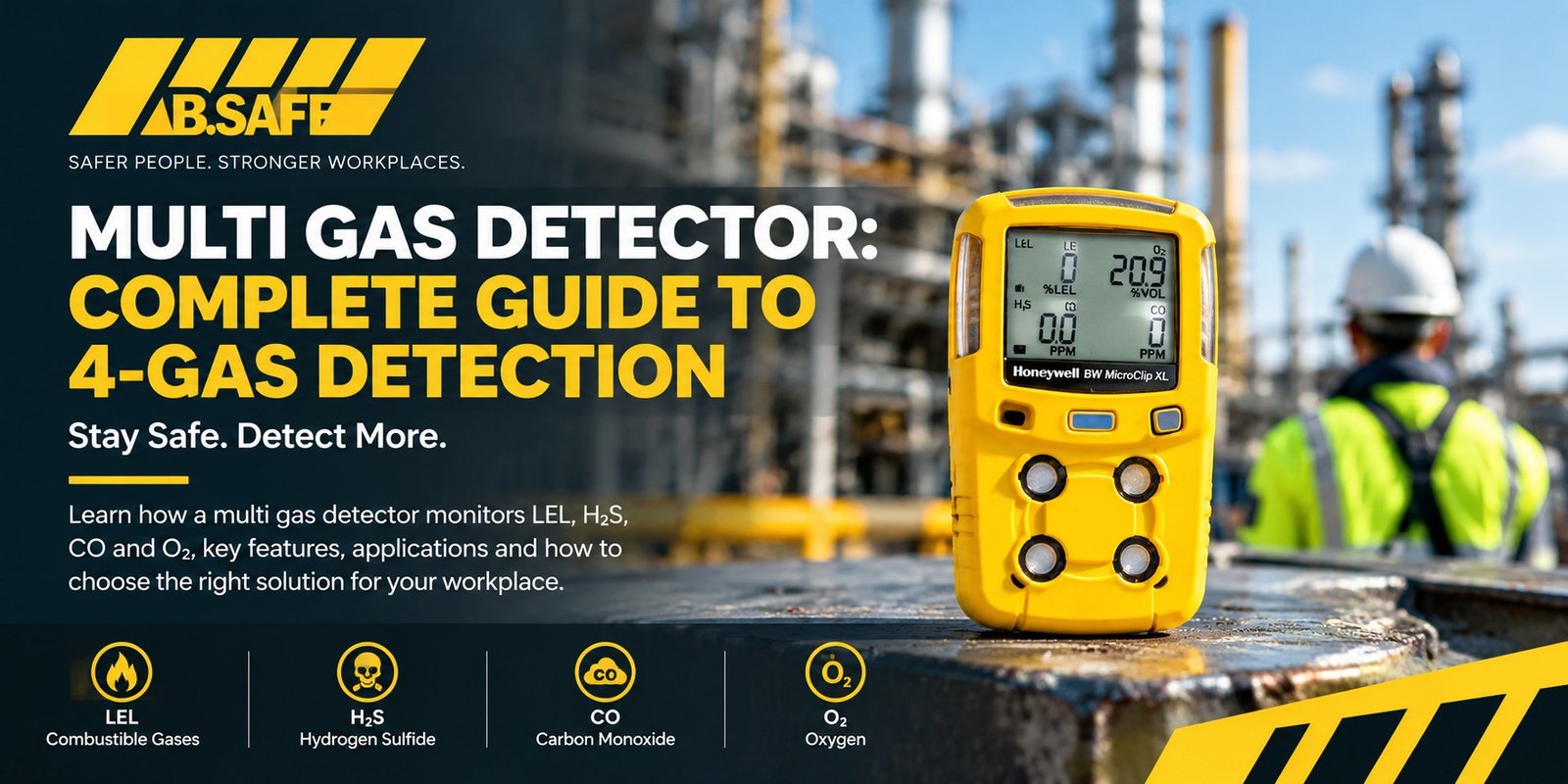
 A Multi Gas Detector is designed to monitor more than one atmospheric hazard with a single portable device. One of the most common configurations is a 4-gas detector that monitors combustible gases through LEL, hydrogen sulfide (H₂S), carbon monoxide (CO), and oxygen (O₂).
This guide explains how multi-gas detectors work, which gases they monitor, where they are used, and what to consider when selecting a portable gas detector for workplace safety.
What Is a Multi Gas Detector?
A Multi Gas Detector is a portable gas monitoring device that uses multiple sensors to detect different atmospheric hazards at the same time.
Unlike a single-gas detector, which is designed to monitor one specific gas, a multi-gas detector can combine several sensors into one compact instrument.
A typical 4-gas detector may monitor:
- LEL – combustible or flammable gases
- H₂S – hydrogen sulfide
- CO – carbon monoxide
- O₂ – oxygen concentration
For example, the Honeywell BW™ MicroClip XL is a portable multi-gas detector designed to monitor LEL, H₂S, CO and O₂ simultaneously. Honeywell lists sensor ranges of 0–100% LEL, 0–100 ppm H₂S, 0–500 ppm CO and 0–30% O₂ for the MicroClip series.
Why Is Multi-Gas Detection Important?
Different workplaces can expose employees to different atmospheric hazards.
A worker in an oil and gas facility, for example, may encounter combustible gases and hydrogen sulfide. A worker in a poorly ventilated area may face oxygen deficiency or carbon monoxide exposure.
The challenge is that many hazardous gases cannot be reliably identified by human senses.
A portable gas detector provides workers with an instrument designed to continuously monitor selected atmospheric hazards and provide alarms when configured thresholds are reached.
Multi-gas detection can therefore provide several measurements from one device, making it practical for workers who need personal monitoring during industrial operations.
What Gases Does a 4-Gas Detector Monitor?
1. LEL – Combustible Gas
LEL stands for Lower Explosive Limit.
The LEL measurement indicates the concentration of combustible gas or vapor in relation to the lower concentration at which combustion can occur.
A detector such as the Honeywell BW MicroClip XL can measure combustible gas from 0–100% LEL.
LEL monitoring can be relevant in environments where combustible gases or vapors may be released, including:
- Oil and gas facilities
- Refineries
- Chemical plants
- Fuel storage areas
- Industrial processing facilities
- Maintenance operations
- Confined spaces
2. H₂S – Hydrogen Sulfide
Hydrogen sulfide is a toxic gas that can occur in several industrial environments.
H₂S monitoring is particularly relevant in applications involving:
- Oil and gas
- Wastewater treatment
- Sewage systems
- Petrochemical facilities
- Industrial processing
- Confined-space work
The Honeywell BW MicroClip XL provides an H₂S detection range of 0–100 ppm.
3. CO – Carbon Monoxide
Carbon monoxide is a toxic gas that can be produced by combustion processes.
Potential sources can include:
- Engines
- Generators
- Furnaces
- Industrial equipment
- Combustion processes
- Vehicles operating in enclosed areas
The Honeywell BW MicroClip XL supports CO monitoring from 0–500 ppm.
4. O₂ – Oxygen
Oxygen monitoring helps identify atmospheric conditions where oxygen concentration is outside the expected range.
This can be particularly important when workers enter enclosed or confined environments where atmospheric conditions may change.
The BW MicroClip XL has an O₂ range of 0–30% by volume.
Multi Gas Detector vs Single Gas Detector
The main difference is the number of atmospheric parameters monitored by the instrument.
| Feature | Single Gas Detector | Multi Gas Detector |
|---|---|---|
| Number of gases | Usually one | Multiple |
| Typical application | Specific gas hazard | Multiple atmospheric hazards |
| Size | Usually very compact | Compact and wearable |
| Monitoring | One selected hazard | Several hazards simultaneously |
| Typical use | Targeted personal monitoring | Industrial and multi-hazard environments |
A single-gas detector can be appropriate when the workplace has a clearly identified single-gas hazard.
A multi-gas detector may be more appropriate when workers could encounter several atmospheric hazards during the same operation.
The correct configuration should always be based on the hazards identified for the specific workplace.
How Does a Multi Gas Detector Work?
A portable multi-gas detector normally contains several sensors inside one instrument.
Each sensor is designed to respond to a particular atmospheric parameter.
The detector processes the sensor signals and displays the measurements on its screen. If a configured alarm threshold is reached, the instrument can alert the worker through multiple alarm methods.
The Honeywell BW MicroClip XL, for example, uses:
- Audible alarms
- Visual alarms
- Vibrating alarms
- LCD gas concentration display
Honeywell also specifies continuous testing of sensors, battery and circuitry, along with audible and visual alarm testing during activation.
What Is a Portable Multi Gas Detector?
A Portable Multi Gas Detector is designed to be carried or worn by a worker while moving through a workplace.
Portability is particularly useful when employees move between different areas and need personal atmospheric monitoring rather than fixed gas detection.
A portable detector should be:
- Lightweight
- Easy to operate
- Easy to read
- Durable
- Suitable for the environmental conditions
- Capable of providing clear alarms
- Appropriate for the gases identified in the workplace
The Honeywell BW MicroClip XL weighs approximately 190 grams and measures approximately 11.3 × 6.0 × 3.2 cm, making it a compact wearable gas monitoring device.
Where Are Multi Gas Detectors Used?
Multi-gas detectors can be used in many industries where atmospheric hazards may be present.
Oil and Gas
Oil and gas facilities may involve combustible gases and toxic gases such as H₂S.
Gas detection can be used during operations, inspections, maintenance and other activities where atmospheric hazards have been identified.
Petrochemical Facilities
Petrochemical processes can involve flammable and toxic substances, making appropriate gas monitoring an important consideration.
Wastewater Treatment
Wastewater environments may present atmospheric hazards including hydrogen sulfide and oxygen-deficient conditions.
Chemical Processing
Chemical facilities may have different gas hazards depending on the processes, chemicals and operating conditions.
Confined Spaces
Confined-space work can present changing atmospheric conditions.
Gas monitoring requirements should be established as part of the site’s confined-space procedures and hazard assessment.
Industrial Maintenance
Maintenance activities may introduce workers into areas where normal operating conditions have changed.
A portable gas detector can provide personal monitoring when the selected sensor configuration matches the identified hazards.
Multi Gas Detector for Confined Space Entry
Confined spaces require particular attention to atmospheric hazards.
Before entering a confined space, organizations should determine:
- Which gases may be present
- Whether oxygen deficiency or enrichment is possible
- Whether combustible gases may be present
- Whether toxic gases are a potential hazard
- What monitoring method is required
- Where measurements should be taken
- What alarm levels and emergency procedures apply
A 4-gas detector commonly monitors LEL, O₂, H₂S and CO, but a standard four-gas configuration does not automatically cover every possible atmospheric hazard.
Detector selection should therefore be based on the specific hazards and conditions identified for the space.
What Should You Look for When Choosing a Multi Gas Detector?
Choosing a gas detector should start with the workplace hazard assessment rather than simply choosing the device with the largest number of features.
Here are several factors to consider.
1. Gas Sensors
First determine which gases need to be monitored.
Common sensor combinations include:
- LEL
- H₂S
- CO
- O₂
Some workplaces may require additional or different sensors.
2. Battery Runtime
Battery runtime is important for workers who need continuous monitoring throughout a shift.
The Honeywell BW MicroClip XL provides typical battery runtime of approximately 18 hours, with Honeywell specifying a minimum 12-hour runtime under its stated cold-weather conditions.
3. Environmental Protection
Industrial environments can expose equipment to dust, moisture and water.
The BW MicroClip XL has an IP68 protection rating.
When comparing detectors, check the manufacturer’s specified protection rating and operating conditions rather than assuming that all portable gas detectors offer the same environmental protection.
4. Alarm System
A gas detector should provide alarms that workers can recognize in their operating environment.
Common alarm methods include:
- Audible
- Visual
- Vibrating
The BW MicroClip XL uses all three.
5. Calibration and Bump Testing
Gas detectors require appropriate testing and calibration according to the manufacturer’s instructions and the organization’s gas detection program.
The Honeywell BW MicroClip XL is compatible with the IntelliDoX docking station for automated bump testing and calibration.
This can be particularly useful for organizations managing multiple gas detectors.
6. Data and Device Management
For larger organizations, managing multiple detectors can become a significant part of the safety process.
The BW MicroClip XL supports device management through Honeywell SafetySuite and Bluetooth Low Energy connectivity.
Honeywell BW MicroClip XL: A 4-Gas Detection Solution
The Honeywell BW™ MicroClip XL is a compact multi-gas detector designed to simultaneously monitor:
LEL + H₂S + CO + O₂
Its specifications include:
- 18-hour typical battery runtime
- 12-hour cold-weather runtime specification
- 190 g weight
- IP68 protection
- One-button operation
- LCD display
- Audible, visual and vibrating alarms
- IntelliFlash™ indicator
- IntelliDoX compatibility
- SafetySuite device management
- BLE connectivity
Honeywell lists a two-year warranty for the MicroClip XL model.
For organizations looking for a portable 4-gas detector, these features make the MicroClip XL a product worth evaluating against the specific requirements of the workplace.
Multi Gas Detector Safety Checklist
Before deploying a portable gas detector, safety teams should consider the following checklist:
Gas Selection
- Have the potential atmospheric hazards been identified?
- Are the selected sensors suitable for those hazards?
- Are additional sensors required?
Equipment
- Is the detector suitable for the operating environment?
- Is the battery sufficient for the expected shift?
- Can workers easily read the display?
- Are alarms appropriate for the working environment?
Testing
- Is bump testing included in the gas detection program?
- Is calibration performed according to applicable requirements?
- Are test and calibration records maintained?
Worker Training
- Do workers understand the detector’s alarms?
- Do workers know what to do when an alarm occurs?
- Are workers trained in the site’s gas detection procedures?
Common Questions About Multi Gas Detectors
What is the most common 4-gas detector configuration?
A common four-gas configuration monitors LEL, H₂S, CO and O₂.
What is the difference between a gas detector and a multi-gas detector?
A gas detector may monitor one or more gases. A multi-gas detector specifically combines multiple gas sensors in one portable instrument.
Is a 4-gas detector suitable for every workplace?
No. The correct sensor configuration depends on the hazards present in the specific workplace.
Can a multi-gas detector be used in confined spaces?
It can be used for atmospheric monitoring in appropriate confined-space applications, but detector selection and monitoring procedures should be based on the site’s hazard assessment and confined-space safety program.
How often should a gas detector be calibrated?
Calibration frequency depends on the manufacturer’s instructions, workplace conditions, detector history and the organization’s gas detection program. Follow the requirements applicable to the specific detector and workplace.
What does LEL mean on a gas detector?
LEL means Lower Explosive Limit. It relates to the lower concentration of a combustible gas or vapor in air that can support combustion.
Why does a gas detector monitor oxygen?
Oxygen monitoring can help identify atmospheric conditions where oxygen concentration is outside the expected range, including potential oxygen-deficient environments.
Conclusion
A Multi Gas Detector can provide workers with simultaneous monitoring of several atmospheric hazards through one portable device.
A typical 4-gas configuration monitors LEL, H₂S, CO and O₂, making it relevant to a range of industrial applications including oil and gas, petrochemical facilities, wastewater treatment, maintenance and selected confined-space operations.
When selecting gas detection equipment, the most important starting point is the actual workplace hazard assessment. Consider the gases that may be present, required sensor ranges, environmental conditions, battery runtime, alarms, testing, calibration and device management.
For organizations evaluating portable gas detection equipment, the Honeywell BW™ MicroClip XL provides a compact four-gas monitoring solution with IP68 protection, 18-hour typical battery runtime and compatibility with Honeywell IntelliDoX and SafetySuite systems.
Explore the Honeywell BW MicroClip XL Multi Gas Detector from B.SAFE for workplace gas detection applications.
Explore Gas Detection Products
If you are looking for reliable gas detection equipment for workplace safety, B.SAFE offers portable gas detectors designed for different monitoring requirements and industrial applications.
Explore the following related products:
Honeywell BW™ MicroClip XL Multi Gas Detector – A portable 4-gas detector designed to monitor LEL, H₂S, CO and O₂, with real-time gas readings, IP68 protection and rechargeable battery operation.
Honeywell BW™ Clip Single Gas Detector – A compact personal gas detector designed for single-gas monitoring applications, available for gases including H₂S, CO, O₂ and SO₂.
Gas Detection Equipment – Explore B.SAFE’s range of gas detection solutions for personal monitoring and workplace hazard detection.
Whether you need a 4-gas detector for industrial applications or a compact single gas detector for personal monitoring, choosing the right equipment should always start with identifying the specific atmospheric hazards present in your workplace.
Explore B.SAFE gas detection products to find the right solution for your workplace safety requirements.