Construction Site Safety Checklist: 15 Things to Check Before Work Starts

Construction Site Safety Checklist: 15 Things to Check Before Work Starts
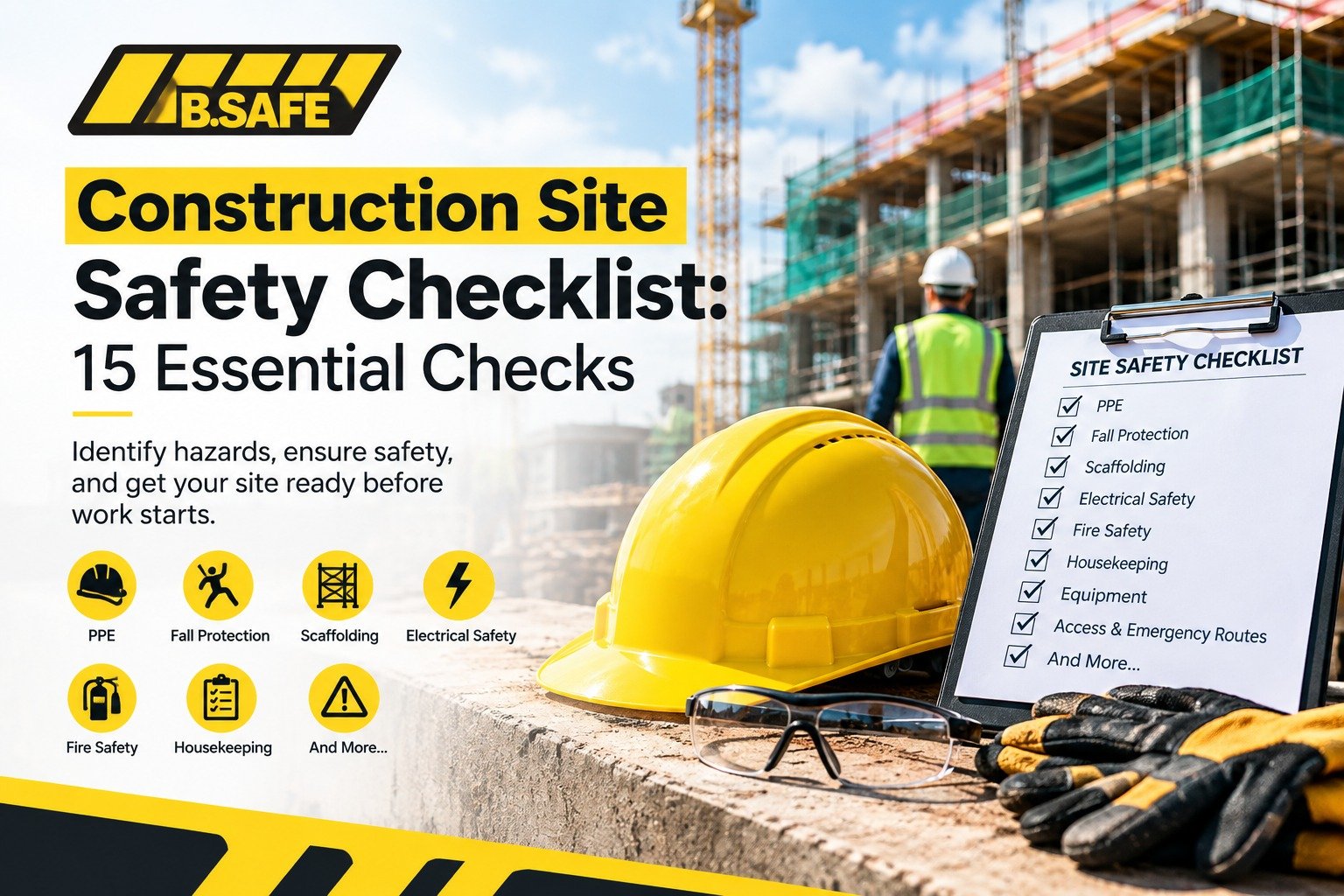
A safe construction site does not happen by accident. Before workers begin their tasks, supervisors and safety teams should identify hazards, check protective equipment, inspect access areas, and make sure the right controls are in place.
A practical construction site safety checklist helps teams identify problems before they lead to injuries, property damage, or work stoppages.
 OSHA highlights four major construction hazards: falls, struck-by hazards, caught-in or between hazards, and electrocution. These hazards should be a major part of any construction safety inspection.
This guide covers 15 important construction site safety checks that supervisors, safety officers, contractors, and workers can use before starting work.
Why Is a Construction Site Safety Checklist Important?
Construction sites change constantly. Materials move, equipment changes location, workers perform different tasks, and new hazards can appear during the project.
A safety inspection checklist provides a structured way to check the site before work begins.
It can help teams:
- Identify hazards before work starts
- Check whether workers have appropriate PPE
- Identify fall hazards
- Inspect scaffolds and ladders
- Control falling-object risks
- Improve housekeeping
- Check access and emergency routes
- Identify electrical hazards
- Verify that equipment is in safe condition
- Reduce preventable accidents
- Improve communication between supervisors and workers
A checklist should support—not replace—competent safety management, risk assessment, training, and the requirements applicable to the specific project.
Construction Site Safety Checklist
Check Personal Protective Equipment
Before workers enter active work areas, confirm that the required personal protective equipment (PPE) is available, suitable for the task, and in good condition.
Depending on the work being performed, PPE may include:
- Safety helmets
- Safety glasses
- Safety gloves
- Safety shoes
- High-visibility clothing
- Hearing protection
- Respiratory protection
- Fall protection equipment
- Face protection
- Task-specific protective equipment
PPE should be selected according to the hazards identified for the specific task.
In Saudi Arabia, employers are required to inform workers about occupational hazards, provide appropriate PPE, and train workers in its use under the occupational safety provisions published by the Ministry of Human Resources and Social Development.
BSAFE tip: PPE should not simply be available on site. Workers should know when and how each item must be used.
Inspect Fall Protection Systems
Falls are one of the most serious hazards in construction.
Before work at height begins, inspect the relevant fall protection measures and confirm that workers understand how to use them.
Depending on the work environment, fall protection may include:
- Guardrails
- Safety nets
- Personal fall arrest systems
- Safety harnesses
- Lifelines
- Anchorage systems
- Temporary edge protection
- Protection around floor openings
OSHA identifies falls as one of its construction Focus Four hazards and provides dedicated resources for fall protection in construction.
For projects using temporary edge protection, the system should be properly selected, installed, inspected, and maintained according to the applicable requirements.
Check Open Edges and Floor Openings
Open edges, shafts, stair openings, lift openings, and other unprotected areas can create serious fall hazards.
Before workers start, inspect the site for:
- Open floor edges
- Floor openings
- Stairwell openings
- Lift shafts
- Roof edges
- Unprotected platforms
- Temporary openings
- Areas where guardrails have been removed
Any identified hazard should be controlled before workers are exposed to it.
Inspect Scaffolding
Scaffolds should be inspected before use and whenever conditions could affect their safety.
Check for:
- Damaged components
- Missing guardrails
- Unsafe access
- Unstable foundations
- Improper assembly
- Overloading
- Missing required protection
- Electrical hazards
- Falling-object risks
OSHA’s scaffold requirements address hazards including falls, falling objects, structural instability, electrocution, and overloading.
Workers should also receive appropriate training on the hazards associated with scaffold use.
Check Ladders and Access Equipment
Ladders are common on construction sites, but damaged or incorrectly positioned ladders can create significant risks.
Before use, check that:
- The ladder is in good condition
- Steps and rungs are not damaged
- The ladder is positioned correctly
- The working area around it is clear
- Workers are using the correct type of ladder
- The ladder is appropriate for the task
- Workers are not using damaged equipment
Do not allow workers to improvise access solutions using unstable materials or unsuitable equipment.
Control Falling Objects and Debris
Construction activities can create falling-object hazards for workers and people below.
Check areas where materials could fall from:
- Scaffolds
- Roofs
- Platforms
- Building edges
- Cranes
- Elevated work areas
- Temporary structures
Depending on the project, controls may include protective barriers, toe boards, safety nets, exclusion zones, debris protection, and appropriate material storage.
OSHA specifically includes struck-by hazards among the Focus Four construction hazards.
For elevated construction work, properly selected safety net systems can provide an additional protective measure against falling workers and materials.
Inspect Construction Equipment
Before work starts, inspect machinery and equipment that will be used during the shift.
Look for:
- Visible damage
- Missing guards
- Fluid leaks
- Damaged cables
- Defective controls
- Unusual wear
- Warning signs
- Missing safety devices
Only trained and authorized workers should operate equipment requiring specific qualifications or training.
Check Electrical Safety
Temporary electrical systems are common on construction sites and require careful inspection.
Check:
- Electrical cables
- Extension cords
- Power tools
- Electrical panels
- Connections
- Grounding or other required protection
- Damaged insulation
- Electrical equipment exposed to unsuitable conditions
Workers should also be aware of overhead power lines and other electrical hazards.
Electrical hazards are one of OSHA’s four major construction hazard categories.
Inspect Excavations and Trenches
Excavation work can create serious risks, including cave-ins, falls, falling materials, and hazardous atmospheres.
Before work begins, confirm that the excavation has been assessed and that appropriate protective measures are in place where required.
Check:
- Excavation stability
- Access and exit
- Edge protection
- Spoil placement
- Nearby equipment
- Water accumulation
- Atmospheric hazards where applicable
- Protective systems
Workers should never enter an excavation simply because it appears stable.
Check Housekeeping
Good housekeeping is one of the simplest ways to reduce unnecessary hazards.
Before work begins, check that:
- Walkways are clear
- Waste is removed
- Materials are stored safely
- Cables are managed properly
- Access routes are unobstructed
- Work areas have adequate lighting
- Slippery surfaces are addressed
- Scrap materials are removed
Poor housekeeping can contribute to slips, trips, falls, blocked emergency routes, and other incidents.
Check Emergency Exits and Access Routes
Workers should know how to leave the work area quickly in an emergency.
Check that:
- Emergency exits are accessible
- Escape routes are clearly identified
- Access routes are not blocked
- Emergency doors can be opened
- Assembly points are known
- Emergency information is available
- Workers understand emergency procedures
Saudi occupational safety provisions also require employers to take precautions against fire and maintain usable safety exits.
Inspect Fire Safety Equipment
Fire hazards can exist during hot work, welding, cutting, electrical work, fuel handling, and other construction activities.
Before starting work, check:
- Fire extinguishers
- Fire exits
- Emergency access
- Hot-work controls where applicable
- Flammable material storage
- Combustible waste
- Emergency procedures
Fire prevention should be considered during the planning stage rather than only after an incident occurs.
Check Material Storage
Improperly stored materials can fall, roll, collapse, or obstruct access routes.
Check that:
- Heavy materials are stored securely
- Materials are not stacked unsafely
- Storage areas are clearly identified
- Materials do not block emergency exits
- Cylinders and hazardous materials are stored appropriately
- Loads are suitable for the storage structure
- Materials are protected from conditions that could damage them
Good material storage also helps improve site organization and productivity.
Check Worker Training and Site Induction
A safe site requires more than equipment.
Workers should understand:
- Site-specific hazards
- Required PPE
- Emergency procedures
- Restricted areas
- Fall hazards
- Equipment hazards
- Reporting procedures
- Safe work practices
- Task-specific risks
New workers should receive an appropriate site induction before beginning work.
Training is particularly important when workers are exposed to high-risk activities.
OSHA’s construction training resources specifically address the Focus Four hazards, PPE, and other construction safety topics.
Check Heat Stress and Weather Conditions
Weather conditions should be considered before outdoor construction work begins.
This is particularly important in hot climates such as Saudi Arabia.
Employers should consider:
- Temperature
- Direct sunlight
- Worker hydration
- Rest areas
- Shade
- Work scheduling
- Signs of heat stress
- Appropriate PPE
- Emergency response
Saudi Arabia’s National Council for Occupational Safety and Health announced that the annual decision prohibiting outdoor work under direct sunlight in the private sector applies from June 15 to September 15, 2026, between 12:00 p.m. and 3:00 p.m. The guidance also emphasizes drinking water, rest and shaded areas, PPE, worker awareness, and monitoring workers during periods of high temperature.
For Saudi construction companies, this makes heat-safety planning an important part of summer site inspections.
Review the Risk Assessment Before Work Starts
A checklist should not be treated as a substitute for a risk assessment.
Before high-risk activities begin, supervisors should review whether the identified hazards and control measures still match the actual work conditions.
Ask:
- Has the work activity changed?
- Have new hazards appeared?
- Has equipment changed?
- Are different workers or contractors involved?
- Has the site layout changed?
- Are weather conditions affecting the work?
- Are additional controls required?
A construction site can change throughout the day, so risk controls should be reviewed when conditions change.
Quick Construction Site Safety Checklist
Supervisors can use this quick checklist before work begins:
| Safety Check | Status |
|---|---|
| Required PPE available and inspected | ☐ |
| Workers understand PPE requirements | ☐ |
| Fall protection systems inspected | ☐ |
| Open edges and floor openings protected | ☐ |
| Scaffolds inspected | ☐ |
| Ladders and access equipment checked | ☐ |
| Falling-object hazards controlled | ☐ |
| Construction equipment inspected | ☐ |
| Electrical hazards controlled | ☐ |
| Excavations inspected | ☐ |
| Walkways and work areas clear | ☐ |
| Emergency exits accessible | ☐ |
| Fire safety equipment available | ☐ |
| Materials stored safely | ☐ |
| Workers received required safety training | ☐ |
| Weather and heat risks assessed | ☐ |
| Risk assessment reviewed | ☐ |
What Are the Most Important Construction Site Hazards?
While every construction project is different, four major hazard categories are repeatedly emphasized in construction safety guidance:
Falls – workers falling from roofs, scaffolds, platforms, ladders, or open edges.
Struck-by hazards – workers being hit by vehicles, machinery, tools, materials, or falling objects.
Caught-in or caught-between hazards – workers being trapped, crushed, or caught between equipment, materials, or structures.
Electrocution – exposure to electrical systems, power lines, tools, cables, and other electrical hazards.
OSHA’s Focus Four program specifically focuses on these four categories.
Construction Focus Four Training
How Often Should a Construction Site Be Inspected?
There is no single inspection schedule that fits every project.
A construction site should be inspected according to the project’s hazards, applicable regulations, company procedures, and changes in working conditions.
Practical inspections may include:
- Before work starts: Check critical hazards and site readiness.
- During the workday: Monitor changing conditions.
- Before high-risk activities: Confirm that task-specific controls are ready.
- After incidents or near misses: Identify what failed and what needs improvement.
- After major site changes: Reassess hazards and controls.
- After severe weather: Check equipment, structures, access routes, and protection systems.
The goal is not simply to complete a form. The goal is to identify hazards and correct them before someone gets hurt.
Final Thoughts
A good construction site safety checklist gives supervisors and workers a practical way to identify hazards before work begins.
From PPE and fall protection to scaffolding, electrical safety, housekeeping, fire protection, and heat stress, every part of the worksite should be considered according to the actual risks present.
For construction companies, contractors, and safety professionals, regular inspections combined with effective training and appropriate safety equipment can help create a safer and more controlled working environment.
Need professional workplace safety equipment or training? BSAFE SAFETY provides PPE, fall protection equipment, industrial safety products, and professional safety training solutions for businesses and workplaces.