Pedestrian Barriers: Complete Guide to Warehouse Pedestrian Safety

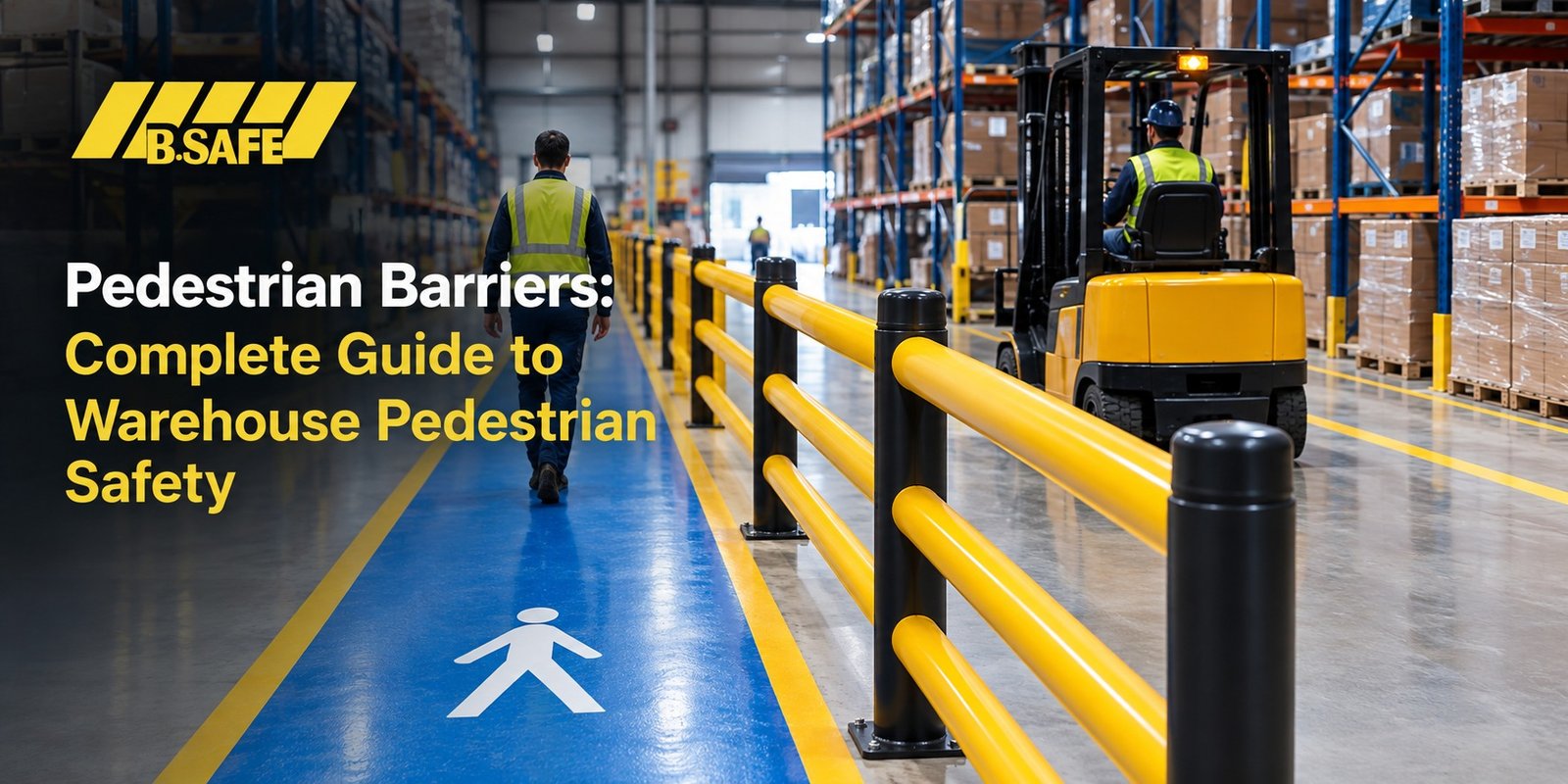
Pedestrian Barriers: Complete Guide to Warehouse Pedestrian Safety
In warehouses, manufacturing facilities, distribution centers, and industrial workplaces, pedestrians often work alongside forklifts, pallet trucks, delivery vehicles, and other moving equipment.
When pedestrian and vehicle routes overlap, clearly defined traffic management and physical separation can help organize movement and reduce unnecessary interaction between people and vehicles.
Pedestrian barriers are one of the solutions used to create physical separation between pedestrian walkways and vehicle traffic while helping define safe routes through the workplace.
This guide explains what pedestrian barriers are, why they are important for warehouse safety, how they support pedestrian and forklift separation, and how to choose the right barrier for an industrial environment.
What Is a Pedestrian Barrier?
A pedestrian barrier is a physical safety system designed to define pedestrian routes and separate people from vehicles, machinery, or other workplace hazards.
Unlike floor markings alone, a physical pedestrian barrier creates a visible and physical boundary between different areas of a facility.
Pedestrian barriers are commonly used in:
- Warehouses
- Distribution centers
- Manufacturing facilities
- Logistics facilities
- Industrial plants
- Storage facilities
- Production areas
- Loading and unloading areas
- Vehicle and pedestrian traffic zones
The specific type of barrier required depends on the workplace layout, vehicle traffic, potential impact conditions, pedestrian movement, and the level of protection required.
Why Are Pedestrian Barriers Important in Warehouses?
Warehouses can contain multiple types of moving equipment operating within relatively limited spaces.
Forklifts and other powered industrial trucks may travel through aisles, intersections, loading areas, storage zones, and production spaces while employees move between workstations.
OSHA specifically identifies pedestrian traffic as an important consideration around powered industrial trucks and recommends separating forklift traffic from workers and pedestrians where possible. Recommended controls include pedestrian walkways, permanent railings or protective barriers, adequate walking space, and floor striping where barriers cannot be used.
A pedestrian barrier can therefore form part of a broader warehouse traffic management strategy.
Pedestrian and Vehicle Separation
One of the main purposes of a pedestrian safety barrier is to create separation between people and moving vehicles.
Instead of allowing pedestrians and vehicles to share the same route, a facility can use physical barriers to define:
Pedestrian areas → Protected walkway → Barrier → Vehicle traffic route
This approach can help make movement through the facility more predictable and easier to understand.
The exact layout should be determined through a site-specific risk assessment that considers vehicle routes, pedestrian movement, intersections, blind corners, doors, loading areas, and other potential hazards.
Forklift and Pedestrian Separation
Forklifts are commonly used for moving pallets, raw materials, finished products, and other loads through warehouses and industrial facilities.
Where forklifts operate near pedestrians, the potential for vehicle-pedestrian interaction needs to be considered as part of workplace traffic management.
OSHA recommends that forklift traffic be separated from other workers and pedestrians where possible and identifies permanent railings or other protective barriers as one option for creating separation.
A forklift pedestrian barrier can help establish a clearly defined boundary between forklift routes and pedestrian walkways.
However, barriers should not be treated as a substitute for a complete traffic management program. Safe vehicle operation, pedestrian awareness, visibility, traffic rules, signage, speed control, and workplace procedures remain important.
Types of Pedestrian Barriers
Different workplaces require different types of pedestrian protection.
1. Three-Rail Pedestrian Barriers
Three-rail pedestrian barriers provide multiple horizontal rails between pedestrians and vehicle traffic.
They can be used to define walkways and separate pedestrians from moving vehicles in warehouses, manufacturing facilities, and industrial environments.
The iFlex Pedestrian Barrier 3 Rail is one example of this type of system. A-SAFE describes it as a flexible, energy-absorbing barrier designed to segregate pedestrians from moving vehicles and workplace hazards while visually defining traffic routes.
2. Pedestrian Guardrails
Pedestrian guardrails are used to create clearly defined walkways and protected areas.
They can be installed around:
- Machinery
- Production areas
- Vehicle routes
- Storage zones
- Warehouse aisles
- Pedestrian crossings
- Hazardous areas
3. Traffic and Pedestrian Barriers
Some systems are designed to provide both pedestrian segregation and higher levels of vehicle impact protection.
These solutions may be appropriate where heavier vehicles operate or where the potential impact energy is higher.
The correct barrier should be selected according to the actual site conditions rather than simply choosing the strongest-looking product.
What Is Pedestrian Segregation?
Pedestrian segregation means separating pedestrians from vehicles, machinery, or other workplace hazards using physical or visual controls.
In a warehouse, pedestrian segregation may involve:
- Dedicated pedestrian walkways
- Safety barriers
- Guardrails
- Floor markings
- Pedestrian gates
- Traffic signs
- Warning systems
- Controlled crossing points
- Vehicle-only routes
Physical segregation is particularly useful where pedestrians and vehicles regularly operate in close proximity.
A well-designed pedestrian segregation system should be easy for both pedestrians and vehicle operators to understand.
Warehouse Traffic Management
Pedestrian barriers should form part of a wider warehouse traffic management plan.
A traffic management system should consider how people, forklifts, delivery vehicles, pallet trucks, and other equipment move through the facility.
Important areas to review include:
Vehicle Routes
Identify the main routes used by forklifts and other vehicles.
Pedestrian Routes
Create clearly defined walkways wherever practical.
Intersections
Pay particular attention to areas where pedestrian and vehicle routes cross.
Blind Corners
Consider visibility and warning measures around corners, doors, and other obstructed areas.
Loading Areas
Loading and unloading zones often have increased vehicle movement and should be assessed separately.
Storage Areas
Racking aisles and storage zones should be reviewed for vehicle movement, pedestrian access, and potential impact points.
Emergency Routes
Emergency exits and access routes should remain clearly identifiable and unobstructed.
Benefits of Pedestrian Safety Barriers
Physical Separation
A barrier creates a physical boundary between pedestrian and vehicle areas.
Clearly Defined Walkways
Barriers can make pedestrian routes easier to identify and follow.
Improved Traffic Organization
Separating different types of movement can help organize traffic through busy facilities.
Increased Visibility
High-visibility barriers can provide a clear visual indication of pedestrian and vehicle zones.
Workplace Protection
Depending on the design and specification, barriers can help protect pedestrians, equipment, infrastructure, and other workplace assets from vehicle movement.
Support for Risk Control
Pedestrian barriers can form part of the engineering controls used to address vehicle-pedestrian interaction identified during a workplace risk assessment.
How Do You Choose the Right Pedestrian Barrier?
Choosing a warehouse pedestrian barrier should start with the actual risks and traffic conditions at the site.
1. Identify the Vehicles
Determine which vehicles operate near pedestrians.
Examples include:
- Forklifts
- Pallet trucks
- Delivery vehicles
- Industrial carts
- Other powered equipment
2. Determine Vehicle Weight and Speed
Vehicle weight and speed influence the potential impact energy.
A barrier designed for pedestrian guidance may not be appropriate for an area exposed to heavier vehicle impacts.
3. Consider Impact Angle
Vehicles do not always strike barriers at 90 degrees.
Turning and maneuvering areas may create shallow-angle impacts, so the potential impact direction should be considered when selecting the system.
4. Map Pedestrian Movement
Identify where employees and visitors regularly walk.
Look for areas where pedestrians currently share routes with vehicles.
5. Identify High-Risk Locations
Pay particular attention to:
- Forklift aisles
- Intersections
- Loading bays
- Doorways
- Blind corners
- Production areas
- Racking aisles
- Vehicle turning areas
6. Consider the Facility Environment
Indoor and outdoor environments may have different requirements.
Temperature, weather exposure, cleaning procedures, chemicals, and the condition of the installation area can influence product selection.
7. Consider Maintenance
Look for systems that allow damaged components to be inspected and replaced efficiently.
Flexible Pedestrian Barriers vs. Traditional Metal Barriers
Traditional metal barriers can provide physical separation, but rigid structures may transfer impact forces directly into the barrier and surrounding installation.
Flexible industrial safety barriers are designed differently.
The iFlex system uses an energy-absorbing design intended to cushion and deflect impact forces. A-SAFE’s technical documentation describes a multi-stage energy absorption system and modular construction in which rails and posts can be replaced in situ.
The right solution depends on the specific workplace hazard, vehicle characteristics, required impact performance, and installation conditions.
iFlex Pedestrian Barrier 3 Rail
The iFlex Pedestrian Barrier 3 Rail is designed for pedestrian segregation in environments where vehicles are operating.
A-SAFE describes the system as a flexible, energy-absorbing barrier that visually defines traffic routes and physically protects pedestrians and vehicle drivers in the event of an impact. It is intended for indoor and outdoor applications and for areas where vehicles operate and there is a risk of collision.
The system can therefore be considered for applications such as:
- Warehouse pedestrian walkways
- Forklift and pedestrian separation
- Manufacturing facilities
- Distribution centers
- Logistics facilities
- Industrial workplaces
- Storage areas
- Vehicle and pedestrian routes
For B.SAFE customers, the iFlex Pedestrian Barrier 3 Rail can be used as part of a wider warehouse safety and traffic management strategy.
Explore the iFlex Pedestrian Barrier 3 Rail.
Where Are Pedestrian Barriers Commonly Used?
Warehouses
Pedestrian barriers can separate employees from forklifts and other warehouse vehicles while defining dedicated walkways.
Distribution Centers
Busy distribution centers can use pedestrian segregation to organize movement between storage, picking, loading, and dispatch areas.
Manufacturing Facilities
Barriers can define pedestrian routes around production equipment and internal vehicle traffic.
Logistics Facilities
Physical separation can help organize pedestrian and vehicle movement in busy logistics environments.
Industrial Plants
Industrial facilities can use pedestrian barriers around vehicle routes, equipment, machinery, and designated walkways.
Loading and Unloading Areas
Where vehicles regularly enter and leave loading areas, barriers can help define pedestrian routes and controlled access points.
Pedestrian Barriers and Workplace Risk Assessment
A pedestrian barrier should be selected based on a workplace risk assessment, not simply because it is a common product in other facilities.
The assessment should identify:
- Hazards
- People at risk
- Vehicle types
- Vehicle speeds
- Traffic routes
- Pedestrian routes
- Potential impact points
- Blind spots
- Intersections
- Existing controls
- Required additional controls
The results can then be used to determine where physical pedestrian segregation is required and what type of barrier is appropriate.
For organizations developing or reviewing workplace risk assessment procedures, see B.SAFE’s Risk Assessment Training resource.
Common Mistakes in Warehouse Pedestrian Safety
Relying Only on Floor Markings
Floor markings can help define routes, but they may not provide physical separation where vehicle and pedestrian interaction is a significant concern.
Creating Pedestrian Routes Without Considering Vehicle Movement
A walkway should be planned alongside vehicle routes rather than independently from them.
Ignoring Intersections
Many interactions occur where pedestrian and vehicle routes cross.
Using the Same Barrier Everywhere
Different areas may have different vehicle weights, speeds, impact angles, and protection requirements.
Failing to Review the Layout
Warehouse traffic patterns can change as storage areas, machinery, production processes, or vehicle routes change.
Treating Barriers as the Only Safety Measure
Barriers are one component of a broader workplace traffic management system.
Warehouse Pedestrian Safety Checklist
Before installing a pedestrian barrier, consider the following:
- Are pedestrian routes clearly identified?
- Are forklift routes clearly defined?
- Can pedestrian and vehicle traffic be separated?
- Are high-risk intersections identified?
- Have blind corners been assessed?
- Have vehicle weight and speed been considered?
- Have potential impact angles been considered?
- Are loading and unloading areas assessed?
- Are emergency routes protected and accessible?
- Has the barrier been selected according to the site’s risk profile?
- Is the barrier suitable for the indoor or outdoor environment?
- Is there a maintenance and inspection plan?
Frequently Asked Questions
What is a pedestrian barrier?
A pedestrian barrier is a physical safety system used to define pedestrian routes and separate people from vehicles, machinery, or other workplace hazards.
Why are pedestrian barriers used in warehouses?
They are used to create physical separation between pedestrians and vehicle traffic, define walkways, and support warehouse traffic management.
Can pedestrian barriers separate forklifts from pedestrians?
Yes. Pedestrian barriers can be used to establish physical separation between forklift routes and pedestrian walkways. OSHA identifies permanent railings and protective barriers as one method for separating pedestrians from powered industrial trucks where possible.
What is pedestrian segregation?
Pedestrian segregation is the separation of pedestrians from vehicles or other workplace hazards using physical, visual, or procedural controls.
Are floor markings enough for pedestrian safety?
Floor markings can help define routes, but they do not provide the same physical separation as a barrier. The appropriate control depends on the specific workplace risk.
What is the iFlex Pedestrian Barrier 3 Rail?
The iFlex Pedestrian Barrier 3 Rail is a flexible industrial pedestrian barrier designed to segregate pedestrians from moving vehicles and workplace hazards while defining traffic routes.
Where can iFlex Pedestrian Barrier 3 Rail be used?
It can be used in warehouses, manufacturing facilities, distribution centers, logistics environments, and other indoor or outdoor workplaces where pedestrian and vehicle traffic need to be separated.
How do I choose a warehouse pedestrian barrier?
Consider vehicle type, weight, speed, impact angle, pedestrian movement, facility layout, environmental conditions, and the required level of impact protection. A site-specific risk assessment can help determine the appropriate solution.
Conclusion
Effective warehouse pedestrian safety requires a combination of planning, traffic management, employee awareness, and appropriate physical controls.
Pedestrian barriers can play an important role by creating clearly defined walkways and separating pedestrians from moving vehicles.
For warehouses, manufacturing facilities, distribution centers, and industrial workplaces, the right barrier should be selected according to the site’s actual traffic patterns, vehicle characteristics, potential impact conditions, and risk assessment.
The iFlex Pedestrian Barrier 3 Rail is one solution designed specifically for pedestrian segregation and vehicle separation, combining visible route definition with flexible impact protection.
Explore the iFlex Pedestrian Barrier 3 Rail or browse B.SAFE’s Warehouse Solutions for additional workplace protection solutions.