Portwest PPE: Essential Personal Protective Equipment for Industrial Work

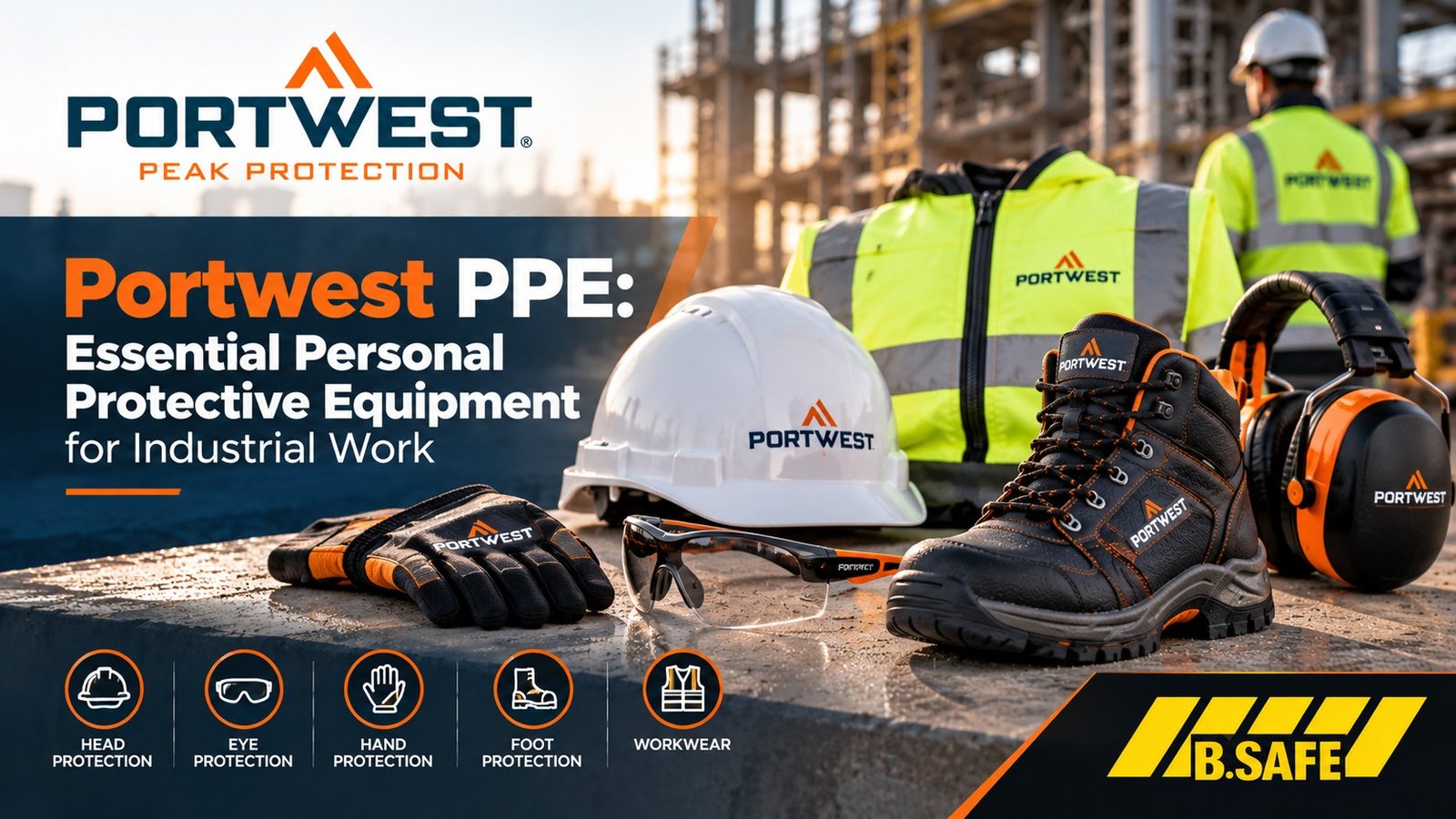
Portwest PPE: Essential Personal Protective Equipment for Industrial Work
Personal protective equipment plays an important role in reducing workplace risks across industrial, construction, manufacturing, warehouse, and maintenance environments. Selecting suitable equipment starts with understanding the hazards workers face and identifying the protection required for each task.
 Portwest PPE includes a range of workplace safety products designed for different occupational needs. At B.SAFE, businesses can explore selected Portwest products, including protective gloves, safety eyewear, head protection, and fall protection equipment.
This guide explains the main categories of personal protective equipment, how to select suitable products, and what to consider when building an effective workplace PPE program.
What Is Personal Protective Equipment (PPE)?
Personal protective equipment, commonly known as PPE, refers to equipment worn or used by workers to help reduce exposure to workplace hazards.
Depending on the task, PPE may protect the hands, eyes, head, feet, body, or other parts of the worker. Fall protection equipment may also be required when working at height.
PPE should be selected as part of a wider workplace safety program. It does not replace hazard elimination, engineering controls, safe working procedures, or appropriate training.
Common PPE categories include:
- Protective gloves for task-specific hand hazards.
- Safety glasses and goggles for eye protection.
- Safety helmets or bump caps for the hazards they are designed to address.
- Protective clothing for thermal, chemical, mechanical, or other specified risks.
- Safety footwear for relevant foot hazards.
- Fall protection equipment for suitable work-at-height applications.
The appropriate combination depends on the workplace risk assessment and the manufacturer’s specifications for each product.
Why Choose Portwest PPE?
Portwest supplies workwear and safety equipment for a variety of occupational applications. Its products cover multiple PPE categories, allowing businesses to evaluate different solutions for their workplace requirements.
When reviewing Portwest PPE at B.SAFE, consider the following factors.
1. Match Equipment to the Hazard
Start by identifying the risks associated with each task. A glove suitable for one activity may not protect against another hazard, and safety glasses designed for impact protection may not provide the chemical splash protection required for a different task.
Choose equipment according to its documented protective capabilities rather than its general product category alone.
2. Check Product Standards and Specifications
Review the product label, technical documentation, applicable standards, and stated limitations before selecting PPE.
Certification and performance requirements differ between product types. Never assume that all gloves, eyewear, helmets, or fall protection equipment offer the same level of protection.
3. Consider Fit and Comfort
PPE must fit correctly and allow workers to perform their tasks safely. Poor fit can reduce usability, affect movement, or encourage workers to remove equipment when they should be wearing it.
Where relevant, consider sizing, adjustability, compatibility with other equipment, and comfort during long shifts.
4. Inspect and Maintain Equipment
PPE should be inspected, stored, cleaned, and replaced according to the manufacturer’s instructions and workplace procedures.
Damaged, contaminated, expired, or otherwise unsuitable equipment should not remain in service when its protective capability can no longer be relied upon.
Essential Portwest PPE Categories Available at B.SAFE
B.SAFE lists selected Portwest products across several workplace safety categories. The following examples illustrate products businesses can evaluate when planning their PPE requirements.
1. Protective Gloves for Industrial Work
Hand protection is important in environments where workers may encounter chemical contact, cuts, abrasion, sharp materials, or other hand hazards.
The correct glove depends on the task. Chemical protection, cut resistance, and mechanical protection are different requirements, and one glove should not be assumed to address them all.
AB810 Chem 320 Nitrile Essential Multipack
The Portwest AB810 Chem 320 Nitrile Essential Multipack is listed by B.SAFE as a green nitrile glove multipack.
When evaluating this product, review its technical documentation for the intended applications, chemical resistance, relevant standards, sizing, and limitations. Nitrile construction alone does not establish suitability for every chemical.
Before selecting chemical protective gloves, identify the substances involved, the expected exposure duration, and the manufacturer’s compatibility guidance.
AC01 Chainmail Glove
The Portwest AC01 Chainmail Glove is another product listed in the B.SAFE Portwest range.
Chainmail gloves are associated with specialized applications involving particular cut or laceration hazards. Their suitability depends on the work being performed and the manufacturer’s stated protective capabilities.
They should not be treated as universal gloves for chemical exposure, heat, or every type of mechanical hazard.
2. Safety Eyewear for Eye Protection
Eye protection helps reduce exposure to hazards such as flying particles and other workplace risks when the selected eyewear is designed and rated for the task.
Employers should assess whether workers need safety glasses, goggles, or other specialized eye and face protection.
BRAVA2 CLEAR Safety Glasses
The Portwest BRAVA2 CLEAR Safety Glasses are available through B.SAFE’s Portwest product range.
Before choosing this model, check the manufacturer’s specifications for impact protection, applicable standards, lens characteristics, fit, and intended applications.
Safety glasses are not automatically suitable for chemical splashes, welding radiation, or every other eye hazard. Select the correct protection for the work activity.
3. Head Protection for Workplace Hazards
Head protection requirements vary according to the risk. Some workplaces require safety helmets designed to protect against specified impacts, while other environments may benefit from bump caps designed for minor bumps against stationary objects.
These products are not interchangeable.
A bump cap should not be used as a substitute for an industrial safety helmet where certified helmet protection is required.
Portwest PW59 Bump Cap
B.SAFE lists the Portwest PW59 Bump Cap among its Portwest products.
Consider a bump cap only when its intended use matches the workplace risk assessment. Verify the product’s documentation and limitations, particularly if workers may face falling-object hazards or other risks requiring a safety helmet.
For environments where certified industrial head protection is mandatory, choose equipment that meets the applicable requirements.
4. Fall Protection Equipment for Work at Height
Working at height can expose workers to serious fall hazards. Where collective protection and other risk controls do not eliminate the risk, a suitable personal fall protection system may be required.
Equipment must be selected as part of a complete system, considering the task, anchor arrangements, clearance, compatibility, training, inspection, and rescue planning.
FP92 20m Rope Guided Fall Arrest
The Portwest FP92 20m Rope Guided Fall Arrest is listed by B.SAFE as a rope-guided fall arrest product.
Before selecting it, confirm the exact system components, compatible equipment, applicable standards, permitted configuration, and manufacturer’s instructions.
Fall protection equipment must not be chosen based on rope length alone. The complete system must be suitable for the work-at-height application, and users must receive appropriate training.
How to Choose the Right PPE for Your Workplace
A practical PPE selection process helps businesses avoid choosing equipment that does not address the actual risks.
Step 1: Conduct a Workplace Risk Assessment
Identify the hazards associated with each task and determine who may be exposed.
Consider factors such as sharp edges, chemical contact, flying particles, falling objects, noise, heat, and work at height. The assessment should reflect the actual working conditions rather than assumptions based on the industry alone.
Step 2: Apply the Hierarchy of Controls
PPE is an important part of workplace safety, but it should not be the only control considered.
Where possible, eliminate hazards or reduce them through engineering controls, safe work practices, and other effective measures. Use PPE to address the remaining risks according to the applicable safety requirements.
Step 3: Select the Correct Product Category
Identify the type of equipment required for each hazard.
For example, chemical exposure may require suitable chemical protective gloves and eye protection, while work at height may require a compatible fall protection system.
Do not assume a product is appropriate merely because it is marketed as industrial PPE.
Step 4: Verify Standards and Compatibility
Review product documentation and confirm that the equipment meets the applicable requirements.
If several PPE items must be worn together, check that they are compatible. For example, eyewear must fit correctly with other required equipment, and fall protection components must be used in the configurations approved by their manufacturers.
Step 5: Train Workers in Correct Use
Workers should understand when PPE is required, how to wear it correctly, what its limitations are, and how to inspect it.
Specialized equipment, particularly fall protection systems and chemical protective equipment, may require specific training and procedures.
Step 6: Establish Inspection and Replacement Procedures
Set clear rules for inspection, cleaning, storage, maintenance, and replacement.
Follow the manufacturer’s instructions and remove unsuitable equipment from service. For equipment with a defined service life or inspection schedule, follow the documented requirements.
Common PPE Selection Mistakes
Choosing Equipment Without Assessing the Hazard
Different hazards require different protective features. Selecting PPE based only on its name or general category may leave workers inadequately protected.
Assuming One Product Protects Against Every Risk
A glove designed for a particular mechanical hazard may not provide suitable chemical protection. Safety glasses may not replace goggles where splash protection is necessary, and bump caps do not replace safety helmets where helmet protection is required.
Ignoring Compatibility
PPE must work as a coordinated system where multiple items are used together. Incompatible products can interfere with fit, movement, or protective performance.
Neglecting Training and Inspection
Even suitable PPE can become ineffective if it is incorrectly used, poorly maintained, or damaged. Training and inspection are essential parts of an effective PPE program.
Explore Portwest PPE at B.SAFE
Choosing suitable personal protective equipment starts with understanding the workplace risks and matching each product to its intended application.
B.SAFE provides access to selected Portwest products, including protective gloves, safety eyewear, head protection, and fall protection equipment.
Explore these product pages:
- AB810 Chem 320 Nitrile Essential Multipack
- AC01 Chainmail Glove
- BRAVA2 CLEAR Safety Glasses
- FP92 20m Rope Guided Fall Arrest
- Portwest PW59 Bump Cap
You can also visit the Portwest brand page at B.SAFE to explore additional products.
Before ordering, confirm current pricing, availability, product specifications, applicable certification, and suitability for the intended workplace with the B.SAFE team.
Frequently Asked Questions
What does PPE stand for?
PPE stands for personal protective equipment. It includes equipment designed to help protect workers against specific workplace hazards.
What types of Portwest PPE are available at B.SAFE?
The listed Portwest range includes products such as protective gloves, safety glasses, head protection, fall protection equipment, and other workplace safety products. Check the brand page for the current selection.
How do I choose the right industrial PPE?
Begin with a workplace risk assessment, identify the hazards, determine the required protective performance, and verify the product’s specifications and standards. Consider fit, compatibility, training, inspection, and maintenance as part of the selection process.
Are all protective gloves suitable for chemical handling?
No. Chemical compatibility depends on the glove material, the specific chemical, exposure conditions, and the manufacturer’s documentation. Verify suitability before use.
Can a bump cap replace a safety helmet?
No, not where a certified industrial safety helmet is required. Bump caps are intended for more limited hazards and must be used within the manufacturer’s stated limitations.
Does fall protection equipment require training?
Yes. Workers need appropriate training to select, inspect, fit, and use the equipment correctly. A suitable system also requires consideration of anchor arrangements, clearance, compatibility, and rescue procedures.
Where can I find Portwest PPE products?
Visit the Portwest brand page at B.SAFE to explore available products and their individual specifications.
Conclusion
Selecting the right Portwest PPE means matching each item to the hazards workers face, verifying the product’s protective capabilities, and ensuring that equipment is correctly fitted, maintained, and used.
From protective gloves and safety eyewear to head protection and fall arrest equipment, each product has a specific purpose and limitations. Review the available Portwest products at B.SAFE and confirm their suitability for your workplace before purchasing.