Labnori Spill Control Products: Absorbents, Pads, Socks and Spill Pallets

Labnori Spill Control Products: Absorbents, Pads, Socks and Spill Pallets
Unexpected liquid spills can create serious challenges for industrial facilities, warehouses, workshops, laboratories, and chemical handling areas. A suitable spill control plan helps businesses manage leaks, reduce the spread of liquids, protect workers, and support safer workplace operations.
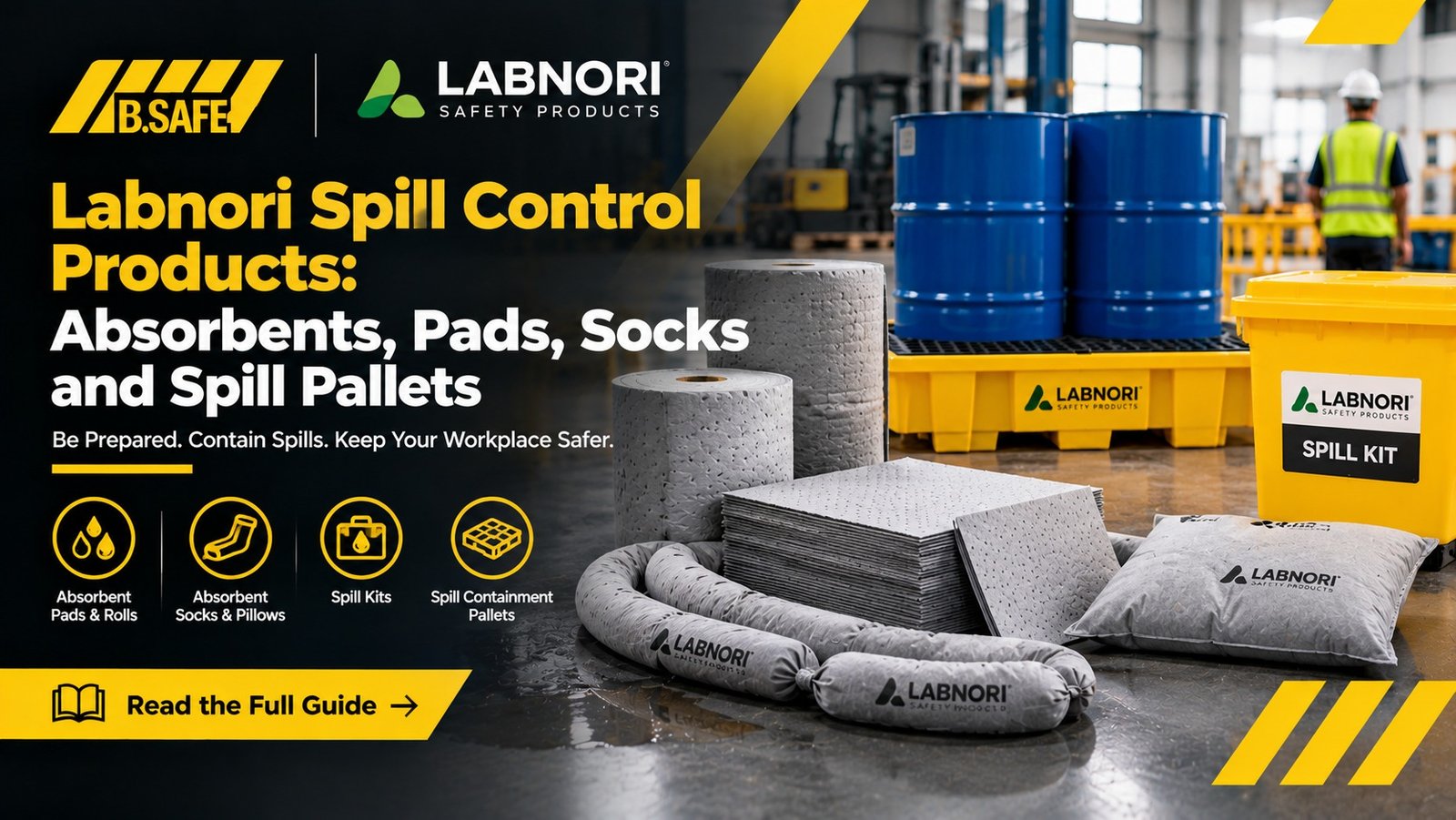
 Labnori spill control products include different types of absorbents and containment equipment designed for spill response and liquid management. Depending on the application, these solutions may include absorbent pads, rolls, socks, pillows, spill kits, and spill containment pallets.
For businesses looking for industrial spill control products in Saudi Arabia, understanding the differences between these solutions is essential before selecting equipment.
At B.SAFE, you can explore the Labnori product range and review available spill control products for your workplace requirements.
What Are Labnori Spill Control Products?
Spill control products are used to absorb, contain, or collect liquids that escape from containers, equipment, storage areas, or industrial processes.
Different products serve different purposes. Some absorb liquid directly, while others help prevent a spill from spreading or provide secondary containment beneath containers.
The main categories include:
- Absorbent pads for small spills, drips, and maintenance tasks.
- Absorbent rolls for covering larger areas or cutting material to the required length.
- Absorbent socks for surrounding leaks and limiting the spread of liquids.
- Absorbent pillows for collecting liquid around leaking equipment.
- Spill kits containing selected materials for emergency response.
- Spill containment pallets and trays for secondary containment beneath containers.
Choosing the right solution starts with identifying the liquid, the potential spill volume, the location, and the risks associated with the substance.
1. Labnori Absorbent Pads
Absorbent pads are practical for routine maintenance, small spills, drips, and localized leaks. They can be placed beneath equipment, near liquid transfer points, or over a spill when the product is suitable for the substance involved.
Their compact format makes them useful in workshops, production facilities, warehouses, and maintenance departments.
When Should You Use Absorbent Pads?
Absorbent pads may be suitable for:
- Collecting small liquid spills.
- Managing drips during maintenance.
- Placing beneath leaking valves or equipment.
- Supporting routine spill response procedures.
- Keeping suitable work areas cleaner and reducing slip hazards.
The appropriate pad depends on the liquid being absorbed.
For example, universal absorbents are designed for a range of common industrial liquids, while oil-only absorbents are intended for oils and petroleum-based liquids and generally repel water. Chemical absorbents must be selected according to the manufacturer’s compatibility guidance.
B.SAFE lists the UPG300 Universal Absorbent Pads, designed for common industrial liquids such as oils, water, coolants, and certain solvents.
2. Oil Absorbent Socks and Chemical Absorbent Socks
Absorbent socks are flexible, elongated products used to surround a spill, contain leaks, or help stop liquids from spreading across a floor.
Unlike flat pads, socks can be positioned around machinery, drums, containers, and other potential leak sources. They can also be used to create a temporary barrier around a localized spill when appropriate for the hazard.
Oil Absorbent Socks
Oil-only absorbent socks are designed to absorb oils and petroleum-based liquids while repelling water, subject to the product’s specifications.
They may be useful in:
- Vehicle maintenance workshops.
- Industrial machinery areas.
- Fuel and lubricant handling locations.
- Warehouses storing oil-based products.
- Suitable outdoor or marine spill response applications.
Explore the OSW120 Oil Absorbent Sock or the OBW301 Oil Absorbent Sock at B.SAFE.
Universal Absorbent Socks
Universal absorbent socks are designed for a wider range of common industrial liquids, depending on the product specifications.
The USG120 Universal Absorbent Sock is one option listed on B.SAFE for containing and absorbing common industrial liquids.
Always verify chemical compatibility before using an absorbent product. Do not assume that a universal absorbent is suitable for every aggressive chemical or hazardous substance.
3. Absorbent Pillows for Leaks and Localized Spills
Absorbent pillows provide a concentrated absorbent format that can be positioned where liquid accumulates or continues to leak.
They may be useful beneath pumps, valves, drums, machinery, and other equipment where pads alone may not provide the required capacity or shape.
Oil Absorbent Pillows
Oil absorbent pillows are designed for oil-based liquids and can be used in suitable maintenance and spill response applications.
B.SAFE lists the POW400 Oil Absorbent Pillow, intended for oil, fuel, lubricants, and other petroleum-based liquids according to its product description.
For hazardous chemicals, use only an absorbent specifically identified by the manufacturer as compatible with the substance involved.
Absorbent pillows do not replace stopping the source of a leak, isolating a hazard, or following the site’s spill response procedure.
4. Labnori Spill Kits for Workplace Preparedness
A spill kit groups selected spill response supplies in one location so trained personnel can access them when an incident occurs.
Depending on the kit, contents may include absorbent pads, socks, pillows, protective equipment, disposal bags, and response instructions.
Types of Spill Kits
Oil-only spill kits
Designed for suitable oil and fuel spills, particularly where the ability to absorb oil while repelling water is important.
Universal spill kits
Designed for a range of common industrial liquid spills, subject to the manufacturer’s stated compatibility.
Chemical spill kits
Designed for specified hazardous chemical spill scenarios. The kit must be appropriate for the chemicals present, and its contents should be checked against the relevant safety data sheets and response procedures.
How to Choose a Spill Kit Capacity
Consider the quantity of liquid that could be released, the size and type of containers, the number of potential spill locations, and the absorbency of the materials included.
Do not choose a spill kit based only on its external container size or advertised capacity. Review the manufacturer’s stated absorption capacity and the substances for which the kit is intended.
Spill kits should be positioned where workers can access them safely. Employees should know when they can respond to a spill and when the incident requires evacuation or specialist assistance.
5. Spill Containment Pallets and Trays
Absorbents help manage liquid that has already escaped. Spill containment pallets and trays serve a different function: they provide secondary containment beneath suitable containers to help collect leaks and prevent liquids from spreading.
They can be important in chemical storage areas, workshops, laboratories, and industrial warehouses.
Spill Containment Pallets
Spill pallets are designed to support selected containers or drums while collecting liquid that may leak from them. The correct pallet depends on the number and type of containers, their combined weight, chemical compatibility, and the required containment volume.
B.SAFE lists the SPC0204 Spill Containment Pallet, which is described as a secondary containment solution for chemical containers and oil drums.
Before choosing a spill pallet, verify its dimensions, load capacity, sump capacity, material compatibility, and suitability for the intended containers.
Spill Trays for Laboratories
Smaller spill trays may be useful for containing liquids beneath laboratory containers or on work surfaces.
Their suitability depends on the container size, the liquid being handled, and the manufacturer’s stated capacity and compatibility.
Spill containment equipment should be inspected regularly and kept in a condition suitable for its intended use.
How to Choose the Right Spill Control Product
Selecting an appropriate spill control product requires more than choosing the largest absorbent or the most convenient kit.
Step 1: Identify the Liquid
Determine whether the liquid is oil, fuel, water-based fluid, coolant, solvent, or a hazardous chemical. Review the safety data sheet (SDS) and follow your workplace’s chemical handling procedures.
Step 2: Check Material Compatibility
Confirm that the selected absorbent or containment product is suitable for the liquid. Oil-only, universal, and chemical absorbents have different intended applications.
Never use an absorbent solely because its appearance or product name suggests it is suitable.
Step 3: Estimate the Potential Spill Volume
Consider the maximum credible release from the relevant container or process. Select absorbents and containment equipment with suitable capacity for the risk being managed.
Step 4: Select the Appropriate Product Format
Use pads for suitable localized spills and drips, socks to help contain spreading liquids, pillows for concentrated absorption around leaks, spill kits for planned response, and containment pallets for secondary containment beneath containers.
These are general applications; the manufacturer’s instructions determine whether a specific product is appropriate.
Step 5: Review Workplace Conditions
Consider floor layout, access routes, drainage, storage arrangements, worker exposure, and the possibility of liquids reaching drains or the surrounding environment.
Step 6: Plan Safe Cleanup and Disposal
Spill response must account for the chemical’s hazards, the risk of exposure, and the correct disposal route for contaminated absorbents.
Do not assume used absorbents can be placed in ordinary waste. Follow the safety data sheet, applicable waste requirements, and your site’s hazardous waste procedures.
Why Industrial Facilities Need a Spill Response Plan
Spill control equipment is most effective when it forms part of a broader workplace safety program.
A practical spill response plan should identify likely spill sources, specify suitable equipment, establish access and isolation procedures, and explain when trained responders or emergency services are required.
It should also include employee training, routine inspection of spill kits, replacement of used materials, and appropriate disposal arrangements.
For hazardous, unknown, highly reactive, or large spills, workers should not attempt cleanup unless they are trained, equipped, and authorized to do so under the site’s emergency procedures.
Explore Labnori Spill Control Products at B.SAFE
Choosing the right spill control solution can help businesses prepare for leaks, manage routine maintenance tasks, and improve their approach to liquid containment.
B.SAFE lists a range of products associated with the Labnori brand, including universal absorbent pads, oil absorbent socks, oil absorbent pillows, and spill containment pallets.
Explore the Labnori brand page to review the listed products and identify options relevant to your workplace.
Before purchasing, confirm the current availability, model specifications, absorption capacity, chemical compatibility, and any applicable documentation with the supplier.
Looking for industrial spill control products in Saudi Arabia? Visit B.SAFE to explore available Labnori solutions for spill absorption, containment, and workplace preparedness.
Frequently Asked Questions
What are Labnori spill control products used for?
They are used for applications such as absorbing suitable liquid spills, containing leaks, supporting spill response, and providing secondary containment beneath selected containers. The intended use depends on the individual product.
What is the difference between universal and oil-only absorbents?
Universal absorbents are designed for a range of common industrial liquids. Oil-only absorbents are intended for oil-based liquids and generally repel water. Always confirm the product specifications before use.
Which absorbent is best for a chemical spill?
There is no single absorbent suitable for every chemical. Identify the substance, consult its safety data sheet, and select a product whose manufacturer confirms compatibility. Unknown or highly hazardous spills may require specialist response.
What is a spill containment pallet used for?
A spill containment pallet provides secondary containment beneath suitable drums or containers, helping collect leaks before they spread. Selection depends on container configuration, load requirements, containment capacity, and chemical compatibility.
What should an industrial spill kit contain?
The contents depend on the expected spill type and risk. A kit may include suitable absorbents, protective equipment, disposal bags, and instructions. Confirm that the contents match the chemicals and spill scenarios present at the facility.
Where can I find Labnori spill control products in Saudi Arabia?
You can start with the Labnori brand page at B.SAFE. Check each product page and confirm current availability and specifications before ordering.
Conclusion
Effective spill management requires the right combination of absorbents, spill kits, and containment equipment for the liquids and hazards present in a workplace.
Labnori spill control products cover several formats, including pads, socks, pillows, kits, and spill containment pallets. Understanding their different purposes helps safety managers and procurement teams make better-informed equipment decisions.
Explore the Labnori product range at B.SAFE to review available spill control solutions for industrial facilities, workshops, warehouses, and other workplaces.