Edge Protection Systems in Construction: Types, Standards and Applications

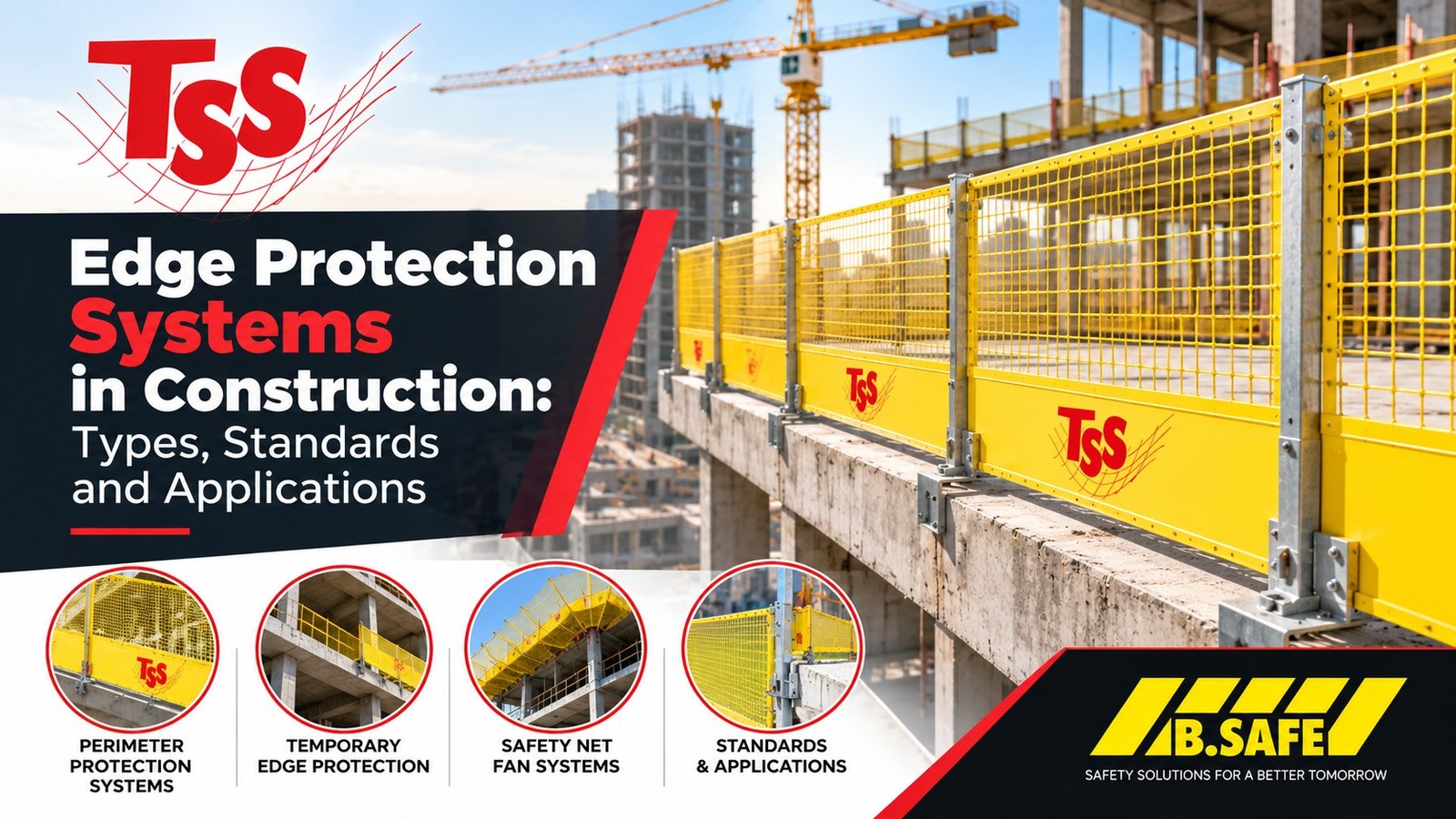
Edge Protection Systems in Construction: Types, Standards and Applications
Falls from unprotected edges are a major hazard on construction sites. Workers installing floors, carrying out roof work, building structural frameworks, or working near open platforms may be exposed to dangerous falls if suitable protection is not in place.
 Edge protection systems help reduce these risks by creating a physical barrier along exposed edges, openings, and other areas where people could fall. When properly selected, installed, and maintained, they form an important part of a construction site’s fall prevention strategy.
In this guide, we explain the main types of construction edge protection, where they are used, which standards may apply, and how to select a suitable system for your project. We also introduce the TSS Meshguard System available through B.SAFE.
What Are Edge Protection Systems?
Edge protection systems are protective barriers installed along exposed edges to help prevent workers, tools, and materials from falling to a lower level.
They are commonly used on:
- Multi-storey building projects.
- Roofs and elevated working platforms.
- Concrete floor slabs during construction.
- Temporary platforms and access areas.
- Industrial facilities undergoing construction or maintenance.
- Areas around certain floor openings and exposed edges.
Depending on the system, edge protection may consist of guardrails, intermediate rails, toe boards, mesh panels, posts, and engineered fixing components.
The purpose is to establish a physical boundary between workers and a fall hazard. The exact configuration must be appropriate for the application and comply with relevant regulations and technical requirements.
Why Is Edge Protection Important on Construction Sites?
Construction work changes continuously as buildings progress. A floor slab that is protected today may have new openings tomorrow, and a roof edge may become accessible when another phase of work begins.
A planned edge protection strategy helps address these changing conditions.
1. Preventing Falls from Height
A suitable barrier can help prevent workers from accidentally stepping or moving beyond an exposed edge. This is particularly important when workers are handling materials, installing equipment, or moving around a busy construction area.
2. Supporting Collective Fall Prevention
Unlike personal fall protection equipment that is worn or connected to an individual worker, edge protection can protect multiple people who use the same designated area.
This makes it a valuable option when the work environment allows an appropriate collective protection system to be installed.
3. Reducing the Risk of Falling Objects
Systems incorporating suitable toe boards or mesh panels may help prevent certain tools and materials from falling over an edge.
However, not every guardrail or mesh barrier provides adequate debris containment. The system must be designed for the specific objects, loads, and conditions involved.
4. Supporting Safer Construction Workflows
Clearly protected boundaries can help workers understand where they can safely perform tasks. They also support site planning by identifying areas that require restricted access, additional protection, or special work procedures.
Types of Construction Edge Protection Systems
Different projects require different types of edge protection. The correct choice depends on the building structure, work activity, installation method, and applicable safety requirements.
1. Temporary Edge Protection Systems
Temporary edge protection is installed during construction or maintenance and removed when it is no longer needed.
Typical applications include:
- Protecting unfinished floor slabs.
- Securing exposed edges during building construction.
- Providing protection around elevated working platforms.
- Supporting temporary roof work.
- Protecting areas where permanent guardrails have not yet been installed.
Temporary systems must be suitable for the structure and stage of construction. Their installation and removal should be planned so workers are not unnecessarily exposed to unprotected edges during either activity.
2. Mesh Panel Edge Protection
Mesh panel systems use rigid or semi-rigid mesh sections supported by posts or other structural components. Depending on their design, they may provide a visible physical barrier and help control access to exposed edges.
Potential applications include building perimeters, elevated platforms, and construction zones where a panel-based protection arrangement is appropriate.
When evaluating a mesh system, check the panel design, connection method, fixing requirements, loading capacity, and compatibility with the supporting structure.
For projects requiring a mesh-based solution, review the TSS Meshguard System at B.SAFE. Confirm the manufacturer’s technical documentation to establish its intended application and installation requirements.
3. Guardrail Systems
Guardrail systems typically use an upper rail, intermediate protection, and other components required by the applicable design and regulations.
They are used to establish a physical barrier along exposed edges and may be installed on floor slabs, platforms, or other suitable structures.
The system must be configured to meet the requirements of its intended use. Rail height, gaps, loading, anchorage, and the strength of the supporting structure should be assessed rather than assumed.
4. Roof Edge Protection
Roof edge protection is designed to help prevent workers from falling from roof perimeters and other exposed roof areas.
The appropriate solution depends on factors such as roof geometry, slope, surface material, access requirements, and the work being performed.
Some systems attach to suitable structural elements, while others use alternative engineered fixing arrangements. The installation method must be compatible with the roof and must not compromise the building’s integrity or waterproofing.
5. Protection Around Openings
Floor openings, service shafts, stairwells, and other openings can create fall hazards even when the main building perimeter is protected.
Depending on the circumstances, protection may involve guardrails, secured covers, barriers, or other suitable measures. A cover must be appropriate for the expected loads and secured against unintended movement.
Edge protection should therefore be considered as part of a complete site assessment, not just as a barrier around the outside of a building.
Edge Protection vs. Fall Arrest Systems: What Is the Difference?
One of the most important decisions in work-at-height planning is understanding the difference between preventing a fall and arresting a fall after it begins.
Edge protection is generally a fall prevention measure. It creates a barrier intended to stop a person from reaching an exposed edge.
A personal fall arrest system, by contrast, is designed to stop a fall after it has occurred, using compatible equipment such as a full-body harness, connecting components, and a suitable anchorage system.
| Feature | Edge Protection System | Personal Fall Arrest System |
|---|---|---|
| Main purpose | Help prevent a person from reaching an exposed edge | Arrest a fall after it begins |
| Protection approach | Physical barrier or perimeter protection | Personal equipment connected to an appropriate anchorage |
| Typical users | Potentially multiple workers in a protected area | Individual workers using compatible equipment |
| Planning requirements | Barrier design, structural support, fixings, and installation | Equipment compatibility, anchorage, clearance, training, and rescue planning |
| Main limitation | Must be suitable for the edge and intended loading | Requires correct use, suitable anchorage, and a workable rescue plan |
These approaches are not interchangeable in every situation. A risk assessment should determine which measures are appropriate and whether multiple forms of protection are necessary.
Where practicable, collective fall prevention should be considered before relying solely on personal fall arrest equipment.
Which Standards Apply to Construction Edge Protection?
The standards and legal requirements for edge protection depend on the country, project type, system design, and intended application.
EN 13374: Temporary Edge Protection Systems
EN 13374 is a European standard addressing temporary edge protection systems used during construction and maintenance. It includes system classifications and requirements relevant to their intended applications.
When evaluating a system, confirm the applicable edition of the standard, the required classification for the project, and the product documentation supplied by the manufacturer.
The appropriate system may depend on factors such as the surface slope, potential fall height, expected loads, and the specific working conditions.
Other Applicable Requirements
Projects may also be subject to national construction safety regulations, employer requirements, structural design criteria, and other standards relevant to the equipment being installed.
Do not assume that a product complies with EN 13374 simply because it is marketed as an edge protection system. Request the relevant technical documentation and evidence of conformity for the exact product and configuration.
How to Choose the Right Edge Protection System
Choosing a suitable system requires an assessment of the work area and the risks involved. The following factors can help guide the selection process.
1. Assess the Work Area
Identify the exposed edges, floor openings, access routes, and activities that could expose workers to falls.
Consider how the site will change during construction. A protection arrangement that works during one phase may need to be adjusted as the building structure develops.
2. Check the Supporting Structure
The system’s posts, brackets, anchors, and connections must be compatible with the supporting structure.
Before installation, confirm that the structure can accommodate the required loads and that the fixing method is suitable. Do not attach protection systems to structural elements without verifying their suitability.
3. Select the Appropriate System Design
Choose a system designed for the specific location and application, such as a slab perimeter, roof edge, or elevated platform.
Check whether the design provides the required barrier configuration and whether additional components, such as toe boards or mesh panels, are necessary.
4. Review Standards and Technical Documentation
Check the manufacturer’s instructions, system limitations, relevant classifications, and applicable regulations.
Where a particular standard is required, verify the evidence for the actual product and installation configuration rather than relying on a general product description.
5. Consider Access and Daily Operations
Protection should support safe work without creating unnecessary obstructions or encouraging workers to remove components.
Plan material handling, equipment movement, deliveries, and access points so the protective barrier remains effective during normal site operations.
6. Plan Installation and Removal
Installation, modification, and removal can expose workers to the same fall hazards the system is intended to control.
These activities should be planned and carried out by competent personnel using suitable procedures and any additional protection required for the task.
7. Establish Inspection Procedures
Inspect the system according to the manufacturer’s instructions and applicable requirements. Check for loose connections, damaged panels, displaced components, deterioration, and signs of unauthorised modification.
After an impact, significant alteration, or event that could affect the system’s integrity, arrange an appropriate assessment before continuing to rely on the protection.
TSS Meshguard System at B.SAFE
When evaluating construction edge protection solutions, it is important to match the product to the site requirements rather than selecting equipment based on its name alone.
The TSS Meshguard System is a product available through B.SAFE for project teams to review as part of their construction safety planning.
Before specifying the system, confirm its intended applications, technical specifications, installation arrangement, compatible fixings, and applicable conformity documentation.
Depending on the project’s requirements, you may also want to evaluate complementary solutions, such as the TSS Safety Net Fan. A safety net system and an edge protection system serve different functions, so each must be assessed according to the hazard it is intended to control.
Visit the TSS brand page to explore the available products and contact B.SAFE for product information.
Common Edge Protection Mistakes to Avoid
Even a suitable system can fail to provide the intended protection if it is selected or used incorrectly. Avoid these common mistakes:
- Choosing a system without assessing the hazard: The product must match the edge, structure, and working conditions.
- Assuming every mesh barrier is compliant: Check the technical documentation and relevant standards for the specific system.
- Ignoring anchorage requirements: Fixings and supporting structures must be suitable for the expected loads.
- Removing barriers without a safe procedure: Any temporary removal must be planned, controlled, and supported by appropriate alternative protection.
- Overlooking floor openings: Protecting the building perimeter does not automatically address every opening or shaft.
- Skipping inspections: Loose connections, damage, and unauthorised changes can undermine the system.
- Treating edge protection as a complete safety plan: Other hazards may require additional controls, training, access arrangements, or personal protection.
Frequently Asked Questions About Edge Protection Systems
What is the main purpose of an edge protection system?
Its main purpose is to help prevent people from falling over exposed edges on roofs, floor slabs, platforms, and other elevated work areas. Some designs may also help prevent objects from falling when configured for that purpose.
What is the difference between edge protection and guardrails?
Guardrails are one type of edge protection. The broader term includes other suitable barrier and panel systems designed to protect exposed edges.
Is EN 13374 relevant to construction edge protection?
EN 13374 addresses temporary edge protection systems used in construction and maintenance. Always confirm the applicable requirements and the evidence of conformity for the specific product and project.
Can mesh panels be used for edge protection?
They can be used when they form part of a system designed for the intended application. The panel, posts, fixings, and supporting structure must meet the relevant requirements.
Is edge protection better than a safety harness?
They serve different purposes. Edge protection can help prevent a fall before it happens, while a personal fall arrest system is intended to arrest a fall. The appropriate solution depends on the risk assessment, site conditions, and applicable requirements.
When should edge protection be inspected?
Inspection should follow the manufacturer’s instructions and applicable regulations. Checks are particularly important after installation, modification, damage, or events that may affect the system’s integrity.
Where can I find TSS edge protection products?
You can review the TSS Meshguard System and explore other available products through the TSS brand page at B.SAFE.
Conclusion
Edge protection systems are an important part of construction safety because they help prevent falls from exposed edges before a worker reaches a dangerous position.
The right solution depends on the work area, supporting structure, required barrier design, applicable standards, and installation conditions. A careful selection process, competent installation, and regular inspection all contribute to effective protection.
If you are planning a construction or industrial project, explore the TSS Meshguard System and contact B.SAFE to request further product information. Confirm the system’s suitability and technical documentation before specifying it for your project.