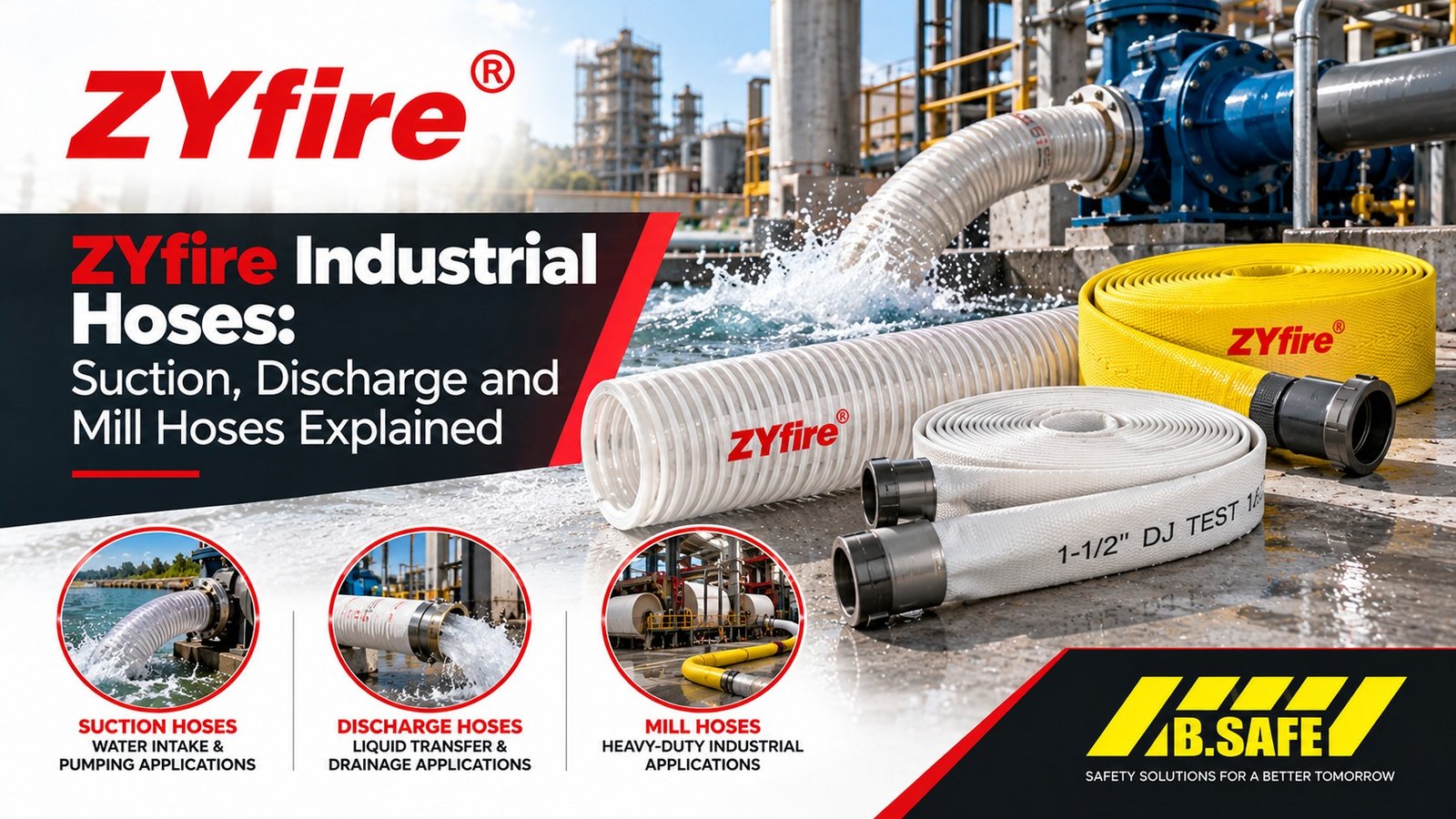
ZYfire Industrial Hoses: Suction, Discharge and Mill Hoses Explained

ZYfire Industrial Hoses: Suction, Discharge and Mill Hoses Explained
Industrial hoses play an essential role in transporting liquids, water, and other materials across manufacturing facilities, industrial plants, construction sites, and processing operations. Selecting the right hose is important for maintaining reliable fluid transfer, supporting operational efficiency, and reducing the risk of equipment failure.
 However, not all industrial hoses are designed for the same purpose. Suction hoses, discharge hoses, and heavy-duty mill hoses have different construction characteristics and operating requirements.
ZYfire offers a range of industrial hose solutions designed for different applications. In this guide, we explore the main types of industrial hoses, their uses, and the factors to consider when selecting the right solution for your operation.
What Are Industrial Hoses?
Industrial hoses are flexible tubes designed to transfer liquids, gases, or other materials between equipment, storage systems, and processing locations.
Unlike ordinary water hoses, industrial hoses are manufactured for specific operating conditions. Their construction may vary according to the material being transferred, operating pressure, temperature, environmental exposure, and mechanical demands.
Industrial hoses are commonly used in:
- Manufacturing and processing facilities.
- Industrial water transfer systems.
- Construction and infrastructure projects.
- Mining and heavy-duty operations.
- Pulp and paper manufacturing.
- Industrial pumping and drainage systems.
- General liquid transfer applications.
Choosing the correct hose requires understanding the difference between suction and discharge applications, as well as the technical requirements of the system.
Main Types of Industrial Hoses
Industrial hoses are available in several configurations. Three important categories are suction hoses, discharge hoses, and specialized mill hoses.
1. Industrial Suction Hoses
Industrial suction hoses are designed for applications where a pump draws liquid or material through the hose.
Unlike a standard delivery hose, a suction hose must be capable of withstanding the negative pressure created during pumping without collapsing under the specified operating conditions.
Depending on their construction, suction hoses may include reinforcement to help maintain their shape during operation.
Common applications include:
- Pumping water from tanks and reservoirs.
- Industrial water intake systems.
- Liquid transfer operations.
- Drainage and dewatering applications.
- Industrial pumping installations.
When selecting a suction hose, consider its vacuum resistance, diameter, length, material compatibility, and operating temperature.
2. Industrial Discharge Hoses
Industrial discharge hoses are designed to transport liquids away from pumps or other equipment.
They are used in applications where the hose must handle the pressure generated by the pumping system.
Depending on their construction and specifications, discharge hoses can support different industrial transfer requirements.
Typical applications include:
- Water discharge from industrial pumps.
- Construction site dewatering.
- Industrial drainage systems.
- Liquid transfer between tanks.
- Manufacturing and processing operations.
Important selection factors include working pressure, burst pressure, hose diameter, connection type, and compatibility with the transferred material.
3. Heavy-Duty Mill Discharge Hoses
Heavy-duty mill discharge hoses are specialized hoses used in demanding industrial environments.
The term mill hose is commonly associated with applications in industries such as pulp and paper manufacturing, where fluid transfer systems may operate under demanding mechanical and environmental conditions.
These hoses should be selected according to the specific material being transferred, pressure requirements, temperature conditions, and installation environment.
A heavy-duty discharge hose may be required where standard hoses are not suitable for the application’s operating demands.
Suction Hose vs. Discharge Hose: What Is the Difference?
Although both types are used for fluid transfer, suction and discharge hoses perform different functions within a pumping system.
| Feature | Suction Hose | Discharge Hose |
|---|---|---|
| Main function | Draws liquid toward a pump | Carries liquid away from a pump |
| Pressure condition | Must withstand specified vacuum conditions | Must withstand specified working pressure |
| Key requirement | Resistance to collapse | Pressure resistance |
| Common use | Water intake and pumping | Water delivery and drainage |
| Selection priority | Vacuum rating and reinforcement | Working pressure and material compatibility |
The most important distinction is the pressure condition under which each hose operates.
A discharge hose should not automatically be used for suction applications, and a suction hose should not be assumed suitable for pressurized discharge. Always check the manufacturer’s specifications.
Introducing ZYfire Industrial Hose Solutions at B.SAFE
B.SAFE offers industrial hose products from ZYfire for different fluid transfer requirements.
Two products worth considering are the Richflex 20 TPR Suction Hose and the Heavy Duty DJ Mill Discharge Hose.
ZYfire Richflex 20 TPR Suction Hose
The Richflex 20 TPR Suction Hose is part of the ZYfire industrial hose range.
It is a suction hose option to consider when evaluating equipment for industrial pumping and liquid intake applications.
Before selecting this product, review its technical documentation to confirm the applicable vacuum rating, working conditions, diameter options, temperature range, and compatibility with the material being transferred.
Explore the product: Richflex 20 TPR Suction Hose
ZYfire Heavy Duty DJ Mill Discharge Hose
The Heavy Duty DJ Mill Discharge Hose is designed for demanding discharge applications associated with industrial mill operations.
When evaluating this hose, buyers should verify its pressure rating, construction materials, available dimensions, and suitability for the intended industrial process.
The correct selection should always be based on the manufacturer’s technical specifications and the operating conditions of the installation.
Explore the product: Heavy Duty DJ Mill Discharge Hose
You can also explore the complete ZYfire product range at B.SAFE.
How to Choose the Right Industrial Hose
Selecting an industrial hose requires matching the product’s specifications to the operating conditions of the system.
Consider the following factors before making a purchasing decision.
1. Identify the Application
Start by determining whether the hose will be used for suction, discharge, or another specialized fluid transfer application.
The application determines the type of hose construction and performance characteristics required.
2. Check Working Pressure and Vacuum Rating
Pressure and vacuum requirements are among the most important selection criteria.
For discharge applications, check the specified working pressure and ensure it is suitable for the pumping system.
For suction applications, confirm that the hose is designed to withstand the required vacuum conditions without collapsing.
Never select a hose based only on its appearance or general product category.
3. Consider Material Compatibility
The hose must be suitable for the liquid or material being transferred.
Different materials can react differently with hose linings and construction components. Check the manufacturer’s compatibility information before using a hose with chemicals, oils, or other specialized fluids.
4. Choose the Correct Diameter and Length
The hose diameter and length affect the overall performance of the fluid transfer system.
An unsuitable diameter may increase flow resistance or create pressure losses. The required dimensions should be determined according to the pump specifications and system design.
5. Evaluate Temperature Requirements
Operating temperature can affect hose flexibility, durability, and material performance.
Check the manufacturer’s minimum and maximum temperature limits to ensure that the hose is suitable for the intended environment.
6. Review Reinforcement and Construction
Industrial hoses may use different reinforcement structures depending on their intended function.
Suction hoses need suitable resistance to vacuum conditions, while discharge hoses require construction appropriate for their working pressure.
The exact construction should be confirmed through the product datasheet.
7. Check Connections and Installation Requirements
The hose must be compatible with the required fittings, couplings, and connection arrangements.
Incorrect connections can lead to leakage, pressure loss, or operational problems.
Always follow the manufacturer’s installation instructions.
Industrial Hose Maintenance and Inspection
Regular inspection is important for identifying damage before it affects the operation of an industrial system.
A suitable inspection routine should follow the manufacturer’s recommendations and the requirements of the specific application.
Important inspection points include:
- Check the hose surface for cracks, cuts, abrasion, or deformation.
- Inspect connections and couplings for signs of leakage or damage.
- Look for bulging, unusual swelling, or other visible changes.
- Check for signs of collapse or deformation in suction hoses.
- Confirm that the hose is operating within its specified pressure and temperature limits.
- Avoid sharp bends, excessive twisting, and unnecessary mechanical stress.
- Replace hoses that show damage or have reached the end of their recommended service life.
Inspection intervals should depend on the operating environment, frequency of use, and manufacturer guidance.
Common Mistakes When Selecting Industrial Hoses
Choosing an unsuitable hose can affect system performance and may create operational risks.
Avoid these common mistakes:
Using a discharge hose for suction applications: Not every discharge hose is designed to withstand vacuum conditions.
Ignoring material compatibility: A hose must be suitable for the substance being transferred.
Selecting based only on diameter: Diameter alone does not determine whether a hose is suitable for a particular application.
Overlooking pressure requirements: The hose must operate within its specified working limits.
Ignoring installation conditions: Bending, abrasion, environmental exposure, and connection requirements can all affect hose performance.
Failing to inspect the hose regularly: Visible damage and deterioration should be addressed before the hose is returned to service.
Frequently Asked Questions About Industrial Hoses
What is the difference between a suction hose and a discharge hose?
A suction hose draws liquid toward a pump and must withstand the specified vacuum conditions. A discharge hose carries liquid away from the pump and must withstand the required working pressure.
What is an industrial mill hose?
An industrial mill hose is a specialized hose used in demanding industrial mill applications, including certain pulp and paper processing operations. Its suitability depends on the materials being transferred and the system’s operating requirements.
Can a suction hose be used as a discharge hose?
Not automatically. A suction hose may have different pressure capabilities from a discharge hose. Always check the manufacturer’s pressure ratings and application guidance before using it in a different role.
How do I choose the correct industrial hose diameter?
The diameter should be selected according to the required flow rate, pump specifications, hose length, and system design. An appropriate technical assessment helps avoid unnecessary flow resistance and pressure losses.
How often should industrial hoses be inspected?
Inspection frequency depends on the application, operating conditions, and manufacturer recommendations. Hoses used in demanding environments may require more frequent inspection.
Conclusion
Industrial hoses are essential components in fluid transfer and pumping systems across many industries. Understanding the differences between suction hoses, discharge hoses, and specialized mill hoses helps buyers select equipment that matches their operational requirements.
When choosing an industrial hose, consider its intended application, pressure or vacuum rating, material compatibility, diameter, temperature range, and connection requirements.
Explore the ZYfire Richflex 20 TPR Suction Hose and the Heavy Duty DJ Mill Discharge Hose through B.SAFE to learn more about available industrial hose solutions.