Delta Plus Fall Protection Equipment: How to Choose the Right System for Working at Height

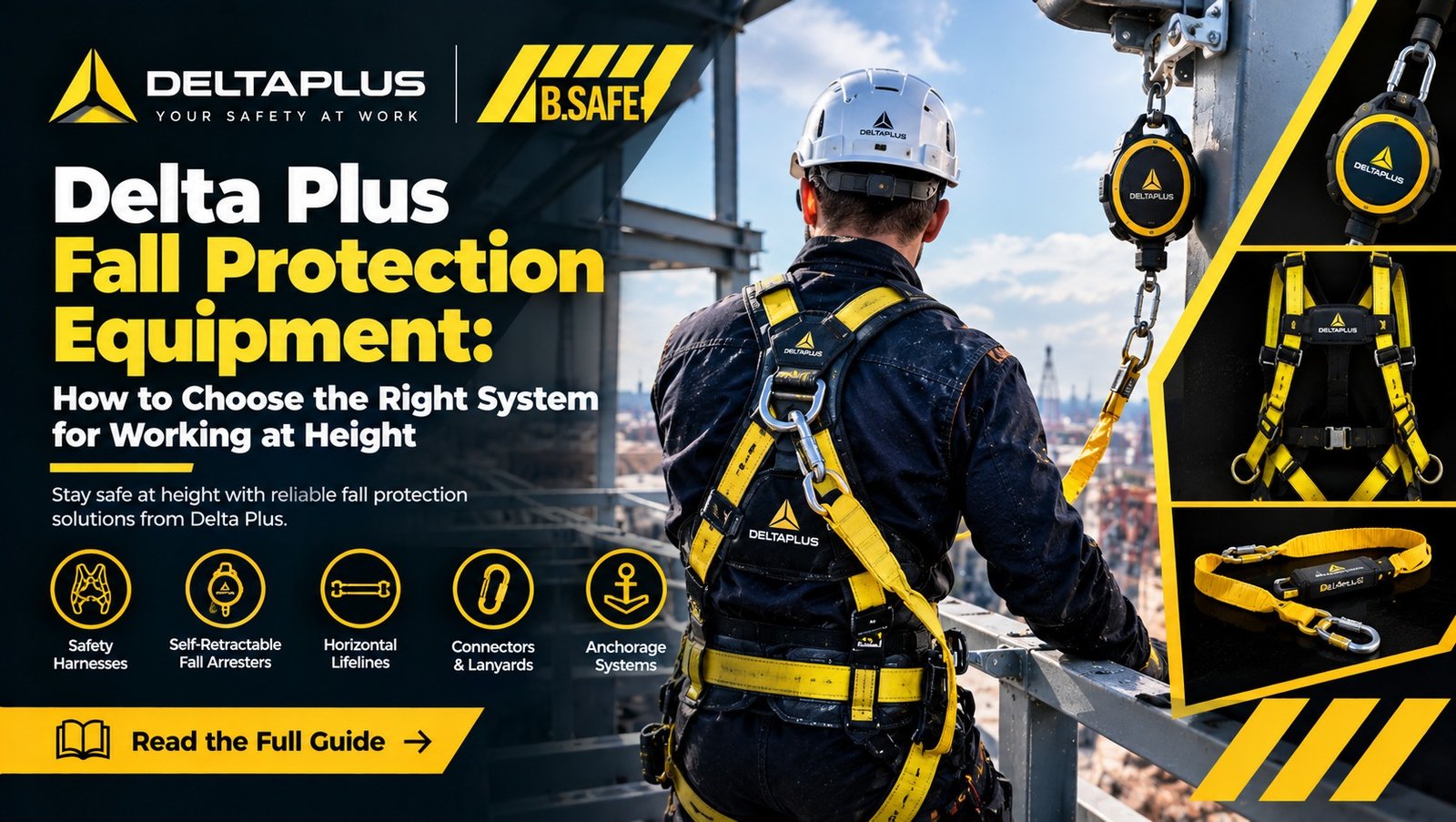
Delta Plus Fall Protection Equipment: How to Choose the Right System for Working at Height
Working at height is one of the most important workplace safety challenges in construction, industrial maintenance, warehousing, and other professional environments. A fall from a roof, platform, ladder, or elevated work area can result in serious injury or death, making proper fall prevention and protection essential.
 Delta Plus fall protection equipment includes products designed for different work-at-height applications, such as fall arresters, safety harnesses, and lifeline systems. Choosing the right equipment requires understanding the hazards, the work being performed, the available anchorage points, and the manufacturer’s instructions.
For businesses in Saudi Arabia, B.SAFE provides access to a range of fall protection products that can be evaluated against workplace requirements. This guide explains the main equipment types, how self-retractable fall arresters work, and what to consider before selecting a fall protection system.
What Is Fall Protection Equipment?
Fall protection equipment refers to devices and systems used to prevent falls or protect workers if a fall occurs.
The appropriate solution depends on the work environment and the risks identified through a workplace assessment. Fall protection may include collective protection measures, such as guardrails, as well as personal protective equipment used in a suitable fall protection system.
Common types of equipment include:
- Safety harnesses: Designed to secure a worker within a compatible personal fall protection system.
- Self-retractable fall arresters: Devices that extend and retract a connecting line and are designed to arrest a fall under specified conditions.
- Lifeline systems: Horizontal or vertical systems that provide a connection for compatible personal protective equipment.
- Connectors and lanyards: Components used to connect a harness to an appropriate anchorage or fall protection device.
- Anchorage systems: Designed attachment points or systems that must meet the requirements for the intended application.
These components are not automatically interchangeable. Compatibility, certification, installation, and the manufacturer’s instructions must be checked before use.
Types of Delta Plus Fall Protection Equipment Available at B.SAFE
B.SAFE lists several Delta Plus fall protection products for different applications. The following options can help safety managers and purchasing teams begin comparing suitable equipment.
1. AN10010T2 Self-Retractable Fall Arrester — 10 m
The Delta Plus AN10010T2 Self-Retractable Fall Arrester is listed as a 10-metre model.
Self-retractable fall arresters are designed to allow a connecting line to extend and retract as the worker moves, while providing a fall-arrest function under the conditions specified by the manufacturer.
When evaluating a 10-metre model, consider the working area, permitted anchorage position, potential fall distance, and clearance required beneath the worker. The line length alone does not establish whether the device is suitable for a particular job.
Before selection, confirm the product’s approved orientation, anchorage requirements, applicable standard, and compatibility with the rest of the system.
View the product: AN10010T2 Self-Retractable Fall Arrester
2. AN18020T Self-Retractable Fall Arrest Block — 20 m
The Delta Plus AN18020T Self-Retractable Fall Arrest Block is listed as a 20-metre option.
A longer line may be relevant for certain work areas where workers need a greater range of movement. However, a longer device is not necessarily suitable for every elevated task.
Before purchasing, assess the anchorage location, potential swing-fall hazards, available clearance, and the device’s permitted operating conditions. The manufacturer’s technical documentation should determine whether the model is appropriate for the intended application.
View the product: AN18020T 20 m Self-Retractable Fall Arrest Block
3. AN18030T Self-Retractable Fall Arrester — 30 m
The Delta Plus AN18030T Self-Retractable Fall Arrester is listed as a 30-metre model.
This product may be worth evaluating for applications requiring a longer connection line, provided the working conditions and manufacturer specifications support its use.
A longer line does not remove the need to calculate fall clearance or verify the anchorage and device configuration. The system must be suitable for the worker’s movement, the potential fall path, and the rescue arrangements in place.
View the product: AN18030T 30 m Self-Retractable Fall Arrester
4. Delta Plus Harness and Lanyard Kit CDD
The Delta Plus Harness and Lanyard Kit CDD is another option to review when planning a personal fall protection system.
A harness and lanyard kit must be appropriate for the specific application. Not every harness and lanyard combination is suitable for arresting a fall, and some lanyards are designed for work positioning or restraint rather than fall arrest.
Check the kit’s exact components, intended use, applicable certifications, and compatibility with the anchorage and other equipment before selecting it.
View the product: Delta Plus Harness and Lanyard Kit CDD
5. H200033 Fall Arrester Harness
The H200033 Fall Arrester Harness is a further product to consider when evaluating harness options.
A harness must fit the worker correctly and be used with compatible equipment according to the manufacturer’s instructions. Incorrect adjustment, unsuitable connections, or incompatible components can compromise the protection system.
Before use, ensure that workers have received appropriate training in inspection, fitting, connection, and the procedures required for their specific work-at-height tasks.
View the product: H200033 Fall Arrester Harness
6. Horizontal Lifeline Systems
For work requiring movement along an elevated route, a horizontal lifeline may be part of the selected fall protection solution.
B.SAFE lists the following options:
Permanent and temporary lifeline systems can differ in their installation requirements, intended applications, and operating limitations.
A lifeline should not be selected based on length or convenience alone. The system design, anchorage capacity, permitted number of users, compatible connectors, and installation instructions must all be verified. Installation and inspection should be performed by appropriately qualified personnel in accordance with the applicable requirements.
Self-Retractable Fall Arrester vs Safety Harness: What Is the Difference?
A self-retractable fall arrester and a safety harness perform different functions. They are often used together, but one does not replace the other.
Self-Retractable Fall Arrester
A self-retractable fall arrester manages a connecting line as a worker moves. When the device detects a fall under its specified operating conditions, it is designed to arrest that fall.
When comparing devices, review:
- Line length and permitted working range.
- Approved anchorage configuration.
- Whether the device is suitable for the intended direction of use.
- Required fall clearance.
- Inspection and maintenance requirements.
- Compatibility with the harness and other components.
The correct device must be chosen according to the task and its technical documentation, not simply the length of the line.
Safety Harness
A safety harness is worn by the worker and forms part of a compatible personal fall protection system.
When selecting a harness, consider:
- Correct fit and adjustment.
- Approved attachment points for the intended application.
- Compatibility with the connecting device.
- Worker comfort during the planned task.
- Inspection, storage, and maintenance requirements.
- Training and emergency rescue procedures.
A harness alone does not prevent or arrest a fall. It must be used as part of a properly selected and configured system.
Which One Do You Need?
The answer depends on the work being performed. A worker may require a harness connected to a self-retractable fall arrester, a suitable lanyard, or a compatible lifeline system.
The complete configuration must be approved for the intended application, with anchorage and clearance requirements properly assessed.
How to Choose the Right Fall Protection Equipment
Selecting suitable Delta Plus fall protection equipment starts with a structured assessment of the workplace.
1. Conduct a Work-at-Height Risk Assessment
Identify where workers will operate, how they will access the work area, and what could happen if they lose their footing or balance.
Consider roof edges, openings, elevated platforms, fragile surfaces, ladders, moving equipment, and changing environmental conditions.
Where practical, prioritize eliminating work at height or using collective protection measures before relying on personal fall protection equipment.
2. Choose the Appropriate Protection Method
Fall prevention and fall arrest are not the same.
- Fall prevention aims to stop a worker from reaching a hazardous edge or falling in the first place.
- Work restraint limits movement so that the worker cannot reach a fall hazard, when the system is correctly designed.
- Fall arrest is intended to stop a fall after it begins.
The selected method must match the risk assessment and the task. Do not use a fall-arrest system as a restraint system unless the equipment and configuration are specifically approved for that purpose.
3. Check the Anchorage and Fall Clearance
The anchorage is a critical part of a personal fall protection system. It must be suitable for the intended application and meet the relevant design and installation requirements.
Available fall clearance must also be assessed. Depending on the equipment and configuration, the calculation may need to account for device deployment, connecting-line behaviour, worker movement, and other factors specified by the manufacturer.
An apparently long or strong device does not guarantee that a worker can be protected safely in every location.
4. Verify Compatibility Between Components
A complete system may include a harness, connector, lanyard or self-retractable device, and anchorage.
Every component must be compatible with the others and suitable for the intended use. Combining products simply because they fit together physically is not sufficient.
Follow the manufacturers’ instructions and relevant safety requirements when selecting and configuring the system.
5. Plan for Rescue Before Work Begins
Arresting a fall is only one part of work-at-height safety. A worker left suspended after a fall may face additional serious risks.
Before work begins, establish a practical rescue plan, identify the necessary equipment and trained personnel, and ensure that emergency arrangements are available at the worksite.
Do not rely solely on emergency services as the only planned response where a prompt workplace rescue is required.
6. Inspect and Maintain Equipment
Equipment should be inspected according to the manufacturer’s instructions and applicable workplace requirements. Conduct the required pre-use checks and arrange formal inspections by competent personnel at the prescribed intervals.
Remove equipment from service when it shows damage, has been involved in a fall-arrest event where the manufacturer requires removal, or has an uncertain service history. Follow the manufacturer’s instructions for quarantine, inspection, repair, and replacement.
Common Fall Protection Mistakes to Avoid
Even appropriate equipment can fail to protect workers when it is selected, installed, or used incorrectly.
Common mistakes include:
- Choosing a device based only on its line length.
- Using an incompatible harness, connector, or lifeline.
- Attaching equipment to an unsuitable anchorage.
- Failing to assess fall clearance and swing-fall hazards.
- Using equipment without the required training.
- Ignoring pre-use checks or inspection requirements.
- Starting work without a practical rescue plan.
- Assuming that a harness alone will prevent a fall.
Employers should ensure that equipment selection, training, supervision, inspection, and emergency planning form part of a complete work-at-height safety program.
Delta Plus Fall Protection Equipment for Industrial Work in Saudi Arabia
Businesses operating in construction, industrial maintenance, manufacturing, and other sectors may need different fall protection solutions depending on their work-at-height activities.
B.SAFE provides access to selected fall protection products that can be reviewed against project and workplace requirements.
Explore the following products:
- AN10010T2 Self-Retractable Fall Arrester — 10 m
- AN18020T Self-Retractable Fall Arrest Block — 20 m
- AN18030T Self-Retractable Fall Arrester — 30 m
- Delta Plus Harness and Lanyard Kit CDD
- H200033 Fall Arrester Harness
- Permanent Horizontal Lifeline
- Speedline LV201 Temporary Horizontal Lifeline
You can also visit the Delta Plus brand page at B.SAFE to explore other available personal protective equipment.
Before purchasing, confirm current stock availability, pricing, product specifications, certification, and suitability for your intended application with B.SAFE.
For related PPE selection guidance, read our articles on Delta Plus Safety Shoes in Saudi Arabia and Delta Plus Safety Gloves.
Frequently Asked Questions
What is Delta Plus fall protection equipment used for?
Fall protection equipment is used to help prevent falls or protect workers if a fall occurs. The appropriate product depends on the work environment, the risk assessment, and the manufacturer’s documented intended use.
What is the difference between a fall arrester and a safety harness?
A fall arrester is a device designed to arrest a fall under specified conditions, while a safety harness is worn by the worker and forms part of a compatible personal fall protection system. Both must be selected and used correctly.
How do I choose between a 10 m, 20 m, and 30 m self-retractable fall arrester?
Compare the working area, anchorage location, required range of movement, clearance, and the manufacturer’s permitted operating conditions. Line length alone does not determine suitability.
Are horizontal lifelines suitable for every roof or elevated work area?
No. The system must be designed and installed for the specific structure and intended application. Anchorage, installation, user limits, compatibility, and clearance must be verified before use.
What should employers check before workers use fall protection equipment?
Employers should ensure that the equipment is suitable for the task, compatible with the other system components, properly inspected, used by trained workers, and supported by an appropriate rescue plan.
Where can I buy Delta Plus fall protection equipment in Saudi Arabia?
You can explore available products through the Delta Plus brand page at B.SAFE. Confirm product specifications, availability, and pricing before placing an order.
Conclusion
Choosing the right Delta Plus fall protection equipment requires more than selecting a harness or a fall arrester. Businesses must assess workplace hazards, choose the appropriate protection method, verify anchorage and fall clearance, confirm compatibility between components, and plan for rescue.
By combining suitable equipment with proper training, inspection, and safe work procedures, employers can make more informed decisions about protecting workers at height.
Explore Delta Plus fall protection products at B.SAFE to compare available equipment for your workplace in Saudi Arabia.