Delta Plus Safety Gloves: Cut Resistance, Heat Protection and How to Choose

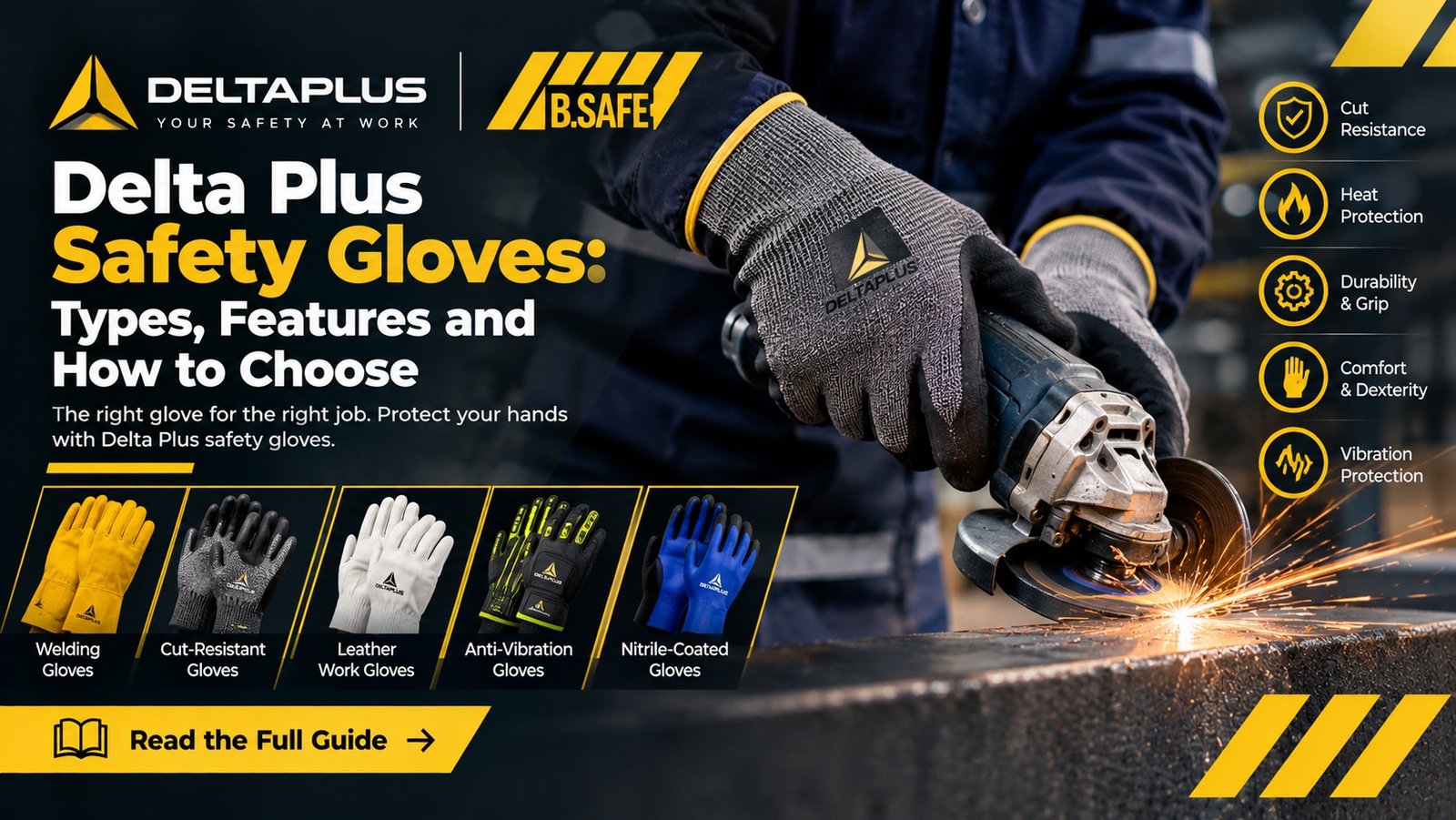
Delta Plus Safety Gloves: Cut Resistance, Heat Protection and How to Choose
Choosing the right safety gloves is essential for protecting workers from hand injuries in industrial and commercial environments. Depending on the task, workers may face sharp edges, hot materials, abrasion, vibration, oils, or other workplace hazards.
 Delta Plus safety gloves are available in different designs for different work applications. Selecting the right pair requires more than choosing a glove by its material or appearance. Employers should identify workplace risks, review the manufacturer’s specifications, and ensure that the selected gloves provide the protection required for each task.
In this guide, we explain the main types of industrial safety gloves, compare common protective features, and explore selected Delta Plus gloves available from B.SAFE for businesses in Saudi Arabia.
Why Are Delta Plus Safety Gloves Important?
Hands are frequently exposed to hazards during manufacturing, maintenance, construction, welding, material handling, and other industrial activities. Suitable protective gloves can help reduce the risk of specific injuries when selected and used correctly.
When comparing Delta Plus safety gloves, consider the following protective requirements:
- Cut resistance: Helps protect against cuts from sharp materials and edges when the glove has the appropriate tested performance.
- Heat protection: Certain gloves are designed for exposure to specified levels of heat, depending on their certification and intended application.
- Abrasion resistance: Helps the glove withstand rubbing and wear during suitable handling tasks.
- Grip: Glove coatings and materials can influence grip when handling dry, wet, or oily objects.
- Vibration protection: Specialized gloves may help reduce exposure to certain types of hand-transmitted vibration, but their performance must be verified for the relevant equipment and task.
- Dexterity and comfort: The glove should allow workers to perform their tasks safely without unnecessary restriction.
No single glove provides the best protection against every hazard. The right choice depends on the task, the environment, and the glove’s documented performance.
Types of Delta Plus Safety Gloves Available at B.SAFE
B.SAFE lists several Delta Plus glove models designed for different work requirements. The following products are useful starting points when comparing available options.
1. CA615K Leather Welding Gloves
The Delta Plus CA615K Leather Welding Gloves are designed for welding-related applications and other suitable industrial tasks involving heat.
The product listing identifies split cowhide leather construction and a length of approximately 350 mm. It also lists standards including EN 388, EN 407, and EN 12477.
These gloves may be worth considering for welding and metal fabrication when their documented protection levels match the process being performed.
Before use, review the product’s technical documentation for its specific thermal performance, mechanical protection, and limitations. Welding gloves should not automatically be considered suitable for every type of welding, molten-metal exposure, or chemical hazard.
View the product: CA615K Leather Welding Gloves
2. Delta Plus Cowhide Leather Work Gloves
The Delta Plus Cowhide Leather Work Gloves are another option to evaluate for suitable general handling and industrial work.
Leather gloves are commonly selected for tasks where the material’s durability and handling characteristics are appropriate. However, protection varies by glove construction, thickness, design, and certification.
Before choosing this model, check the product specifications to determine whether it is suitable for the expected levels of abrasion, tearing, puncture, and other mechanical risks.
View the product: Delta Plus Cowhide Leather Work Gloves
3. VENICUT34 Cut-Resistant Work Gloves
The Delta Plus VENICUT34 Cut-Resistant Work Gloves are relevant for buyers looking for gloves intended to help protect against cut hazards.
Cut-resistant gloves may be useful when handling suitable sharp-edged components, metal parts, glass, or other materials that present a cutting risk.
It is important to select the correct level of protection for the actual hazard. Cut resistance does not mean cut-proof, and performance can vary considerably between glove models. The glove should also provide adequate dexterity and fit for the task.
Do not use cut-resistant gloves near rotating machinery where gloves could become caught unless the machine-specific risk assessment and safety procedures explicitly permit their use.
View the product: VENICUT34 Cut-Resistant Work Gloves
4. VV904 Anti-Vibration Safety Gloves
The Delta Plus VV904 Anti-Vibration Safety Gloves are an option to investigate for work involving vibration-producing tools or equipment.
Vibration exposure should be assessed carefully because different tools and operating conditions can create different risks. Anti-vibration gloves should be selected only after reviewing their documented performance and suitability for the particular equipment and task.
These gloves should not be treated as a replacement for exposure controls, suitable tool maintenance, safe working practices, or other measures required by the workplace risk assessment.
View the product: VV904 Anti-Vibration Safety Gloves
5. VV636BL Wet and Dry Nitrile-Coated Work Gloves
The Delta Plus VV636BL Wet and Dry Nitrile-Coated Work Gloves may be worth comparing for handling tasks where grip and glove coating are important.
Nitrile-coated gloves are used in a variety of handling applications, but their suitability depends on the coating, liner, surface conditions, and manufacturer’s performance data.
Do not assume that a glove described for wet and dry handling is suitable for every oil, solvent, chemical, or liquid. Chemical resistance must be confirmed for the specific substance and exposure conditions.
View the product: VV636BL Wet and Dry Nitrile-Coated Work Gloves
6. VE702 Polyester Knitted Gloves
The Delta Plus VE702 Polyester Knitted Gloves provide another option to review when comparing basic knitted work gloves.
Knitted gloves can be useful for suitable light handling tasks where flexibility and dexterity are important. However, the protection offered by a particular model depends on its construction and specifications.
Before using knitted gloves for industrial work, verify whether the product provides the required protection against abrasion, cuts, or other hazards identified in the workplace assessment.
View the product: VE702 Polyester Knitted Gloves
How to Choose the Right Industrial Safety Gloves
Selecting suitable industrial safety gloves starts with understanding the work rather than choosing a product category alone.
1. Identify the Main Workplace Hazard
Determine what workers will handle and which hazards are present. Common examples include:
- Sharp edges, metal sheets, and cutting tools.
- Hot components and welding operations.
- Rough materials that may cause abrasion.
- Vibration-producing tools.
- Wet surfaces, oils, and other substances.
- Tasks requiring precise finger movement.
Use a workplace risk assessment to identify the required protective features and any situations where gloves could create an additional hazard.
2. Match the Glove to the Task
Different applications call for different glove designs.
For welding and suitable hot-work tasks, compare specialist welding gloves such as the CA615K and confirm their certified protection levels.
For cut hazards, review the documented performance of a model such as the VENICUT34.
For vibration-related tasks, assess the VV904 specifications alongside equipment controls and vibration-exposure procedures.
For handling work, compare the VV636BL nitrile-coated gloves or VE702 knitted gloves only after confirming their suitability for the materials and conditions involved.
These examples are starting points for product evaluation, not substitutes for checking technical documentation.
3. Check the Applicable Safety Standards
Look for the standards and performance markings shown on the product documentation.
Depending on the application, relevant standards may include:
- EN 388: Mechanical risks, including specified tests for abrasion, blade cuts, tearing, puncture, and other applicable performance measurements.
- EN 407: Thermal risks, with performance depending on the specific tests and levels achieved.
- EN 12477: Requirements for protective gloves used by welders.
A standard’s presence does not mean that every glove achieves the same level of protection. Compare the actual performance markings and consult the manufacturer’s instructions.
4. Choose the Correct Size and Fit
Gloves that are too loose can interfere with handling and may introduce additional risks. Gloves that are too tight may restrict movement or cause discomfort.
When selecting gloves for a team, consider:
- Correct hand measurements and sizing.
- Secure fit without excessive restriction.
- Sufficient finger movement for the task.
- Grip and tactile sensitivity.
- Compatibility with any other required PPE.
Workers should be trained to inspect gloves before use and replace them when damaged or when their protective performance may have been compromised.
5. Consider Chemical and Environmental Compatibility
If workers handle chemicals, oils, cleaning agents, or other substances, confirm compatibility with the exact material and concentration.
A glove suitable for mechanical handling may not provide chemical protection. Consult the manufacturer’s chemical-resistance data and consider the duration of contact, temperature, and whether exposure is through splashes or prolonged immersion.
Delta Plus Safety Gloves for Different Industries
The appropriate glove depends on the tasks and hazards present in each industry.
Manufacturing and metalworking: Workers may need gloves selected for mechanical risks, handling requirements, and the materials being processed.
Welding and fabrication: Specialist welding gloves may be required to address heat and other process-specific hazards. The selected model must match the welding procedure and documented protection levels.
Construction and maintenance: Glove selection should reflect handling tasks, sharp materials, abrasion risks, and the need for dexterity.
Warehousing and logistics: Suitable handling gloves may help workers manage materials while maintaining the grip and movement required for their tasks.
Equipment operation: Where vibration is a concern, employers should assess exposure and select appropriate controls. Anti-vibration gloves should be used only when their performance is suitable for the task.
Employers should avoid issuing one glove model for all activities when the risks differ between jobs.
Where to Buy Delta Plus Safety Gloves in Saudi Arabia
B.SAFE offers a range of Delta Plus personal protective equipment for businesses looking for workplace safety solutions in Saudi Arabia.
You can start by browsing the Delta Plus brand page and comparing products according to their intended use and technical specifications.
Selected products include:
- CA615K Leather Welding Gloves
- Delta Plus Cowhide Leather Work Gloves
- VENICUT34 Cut-Resistant Work Gloves
- VV904 Anti-Vibration Safety Gloves
- VV636BL Wet and Dry Nitrile-Coated Work Gloves
- VE702 Polyester Knitted Gloves
Before placing an order, confirm the required sizes, stock availability, current pricing, and technical documentation with B.SAFE.
For related workplace PPE, you can also read our guide to Delta Plus Safety Shoes in Saudi Arabia to explore footwear selection and protection requirements.
Frequently Asked Questions
What are Delta Plus safety gloves used for?
Delta Plus offers different glove models for different applications. Depending on the product and its specifications, options may be intended for welding, mechanical protection, cut hazards, handling tasks, or vibration-related applications.
Which Delta Plus gloves are suitable for welding?
The CA615K Leather Welding Gloves are listed for welding-related use. Review the manufacturer’s documentation and applicable protection levels to confirm that the model is suitable for the specific welding process and associated hazards.
Are cut-resistant gloves cut-proof?
No. Cut-resistant gloves are tested to defined performance levels, but they do not eliminate the risk of cuts. Select the appropriate protection level and follow safe handling procedures.
Can the same safety gloves be used for all industrial tasks?
No. Gloves designed for heat, cutting, mechanical handling, or vibration have different purposes. The correct choice depends on the task, the workplace risk assessment, and the manufacturer’s specifications.
How can I choose the right safety gloves for my business in Saudi Arabia?
Identify the hazards, determine the required protection, check the product standards and performance markings, and confirm fit and compatibility with the work. You can then compare suitable options through the Delta Plus range at B.SAFE.
Conclusion
Choosing the right Delta Plus safety gloves requires matching the glove’s documented performance to the hazards workers face. Welding gloves, cut-resistant gloves, coated handling gloves, and anti-vibration gloves serve different purposes and should not be treated as interchangeable.
By assessing workplace risks, reviewing applicable standards, and selecting products for their intended applications, businesses can make more informed PPE purchasing decisions.
Explore the Delta Plus range at B.SAFE to compare available safety gloves and other protective equipment for your workplace in Saudi Arabia.